About Choloepus hoffmanni Peters, 1858
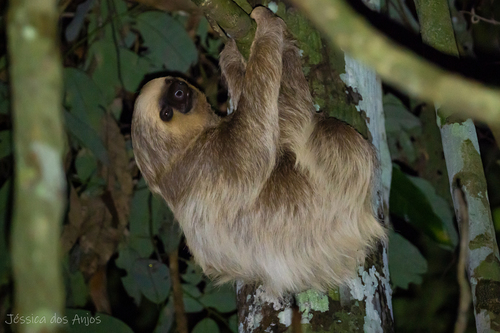
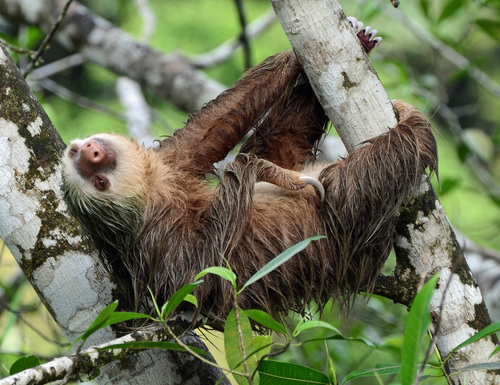
Hoffmann's two-toed sloth (scientific name Choloepus hoffmanni Peters, 1858) is a heavily built animal with shaggy fur and slow, deliberate movements. Each of its fore feet has only two toes, each ending in a long, curved claw, while each hind foot has three clawed toes. Several features distinguish it from three-toed sloths, which can share the same geographic range: it has a longer snout, separate rather than partially fused forefoot toes, no hair on the soles of the feet, fewer dark markings around the eyes, and a larger overall body size. Unique wrist traits have evolved in this sloth to support its slow but acrobatic movement, including reduction and distal migration of the pisiform bone with loss of contact with the ulna; reduction of the distal end of the ulna to a styloid process; and extremely reduced contact between the ulna and triquetral bone. It is much more difficult to distinguish from the closely related Linnaeus's two-toed sloth, which it closely resembles. The main physical differences between the two species are subtle skeletal traits: for example, Hoffmann's two-toed sloth has three foramina in the upper forward part of the interpterygoid space, instead of only two, and often (but not always) has fewer cervical vertebrae. Adult Hoffmann's two-toed sloths have a head-body length ranging from 54 to 72 cm (21 to 28 in) and weigh between 2.1 and 9 kg (4.6 to 19.8 lb). They have stubby tails just 1.5 to 3 cm (0.59 to 1.18 in) long, which are too short to be visible through the animal's long fur. Their claws are 5 to 6.5 cm (2.0 to 2.6 in) long. On average, females are larger than males, though there is considerable overlap in the size range of both sexes. Their fur is tan to light brown, and lighter in colour on the face; it usually carries a greenish tinge from algae that live within the hairs. The species has a karyotype with 2n = 49–51 and FN = 61. Hoffmann's two-toed sloth inhabits tropical forests from sea level up to 3,300 m (10,800 ft) above sea level. It lives in the rainforest canopy across two separate regions of Central and South America, separated by the Andes. One population occurs from eastern Honduras in the north to western Ecuador in the south, while the other lives in eastern Peru, western Brazil, and northern Bolivia. Analysis of cytochrome c oxidase subunit I sequences suggests these two diverged from one another around 7 million years ago. Hoffmann's two-toed sloths live in the canopies of tropical rainforests, and typically rest in the branches of intertwined trees within sheltered treetops. Most of their activity occurs while hanging upside down, but they travel to the ground to urinate and defecate. They also come to the ground when they need to move to a new tree or find new food sources. While the species uses a wide range of trees within its habitat, it appears to prefer trees with plentiful lianas and direct sunlight. Individuals have a typical home range of around 2 to 4 hectares (4.9 to 9.9 acres), and may spend most of their lives moving between only about 25 trees. The reproductive habits of Hoffmann's two-toed sloth differ from those of three-toed sloths. Hoffmann's two-toed sloths can mate throughout the year, with no fixed breeding schedule. Typically though, mating occurs during the rainy season and birth takes place during the dry season. Courtship behavior involves the female licking the male's face and rubbing her genitals against the male's body. Gestation lasts between 355 and 377 days, or roughly 11.5 months, and produces a single young. Hoffmann's two-toed sloths do not form lifelong pair bonds. When females are ready to mate, they produce a loud scream that attracts males; if multiple males are attracted, they fight one another, and the male typically leaves after mating. Males leave scent markings of anal secretions on tree branches to signal their presence to females. This mating pattern may be explained in part by female sloths congregating in small, heterogeneously distributed habitats in some areas, which lets dominant males mate with multiple females with relatively little risk and effort. The territories of male Hoffmann's two-toed sloths generally overlap with one another, and each male's territory surrounds around three females, allowing him to have multiple mating partners. In some cases, the species mates polygynously, with defined territories limiting the number of females a male can breed with. In other cases, it mates promiscuously, when two sloths encounter one another and the opportunity to mate arises. Birth can occur either on the ground or while the mother is hanging upside down. Newborn Hoffmann's two-toed sloths weigh 340 to 454 g (12.0 to 16.0 oz) and are precocial, already having long claws and the ability to cling to their mother's underside. Only the female cares for the young until they become independent. Young sloths begin eating solid food at 15 to 27 days old, and are fully weaned by 9 weeks of age. While adults are relatively quiet, young sloths produce loud bleating alarm calls if they become separated from their mothers. The mother carries and nurses the young for the first 6 to 9 months of life, until the young are able to survive on their own. Hoffmann's two-toed sloths reach sexual maturity between 2 and 4 years of age, and have been recorded living up to 43 years in captivity. In captive observations, a mother giving birth while hanging upside down was seen pulling her infant between her hind limbs to move it onto her abdomen. Other sloths in the group have been observed hanging under a mother and her newborn to protect the infant from falling.