About Choeronycteris mexicana Tschudi, 1844
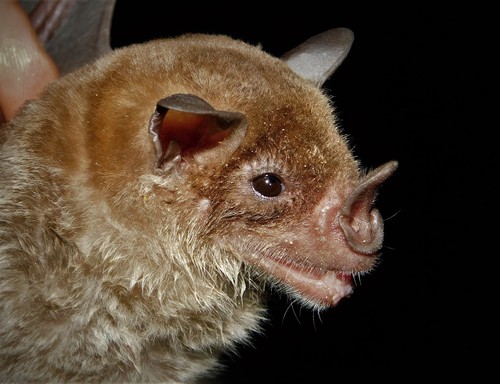
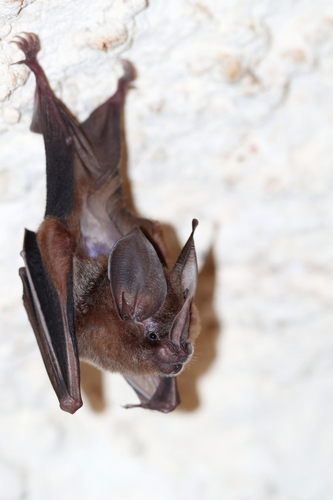
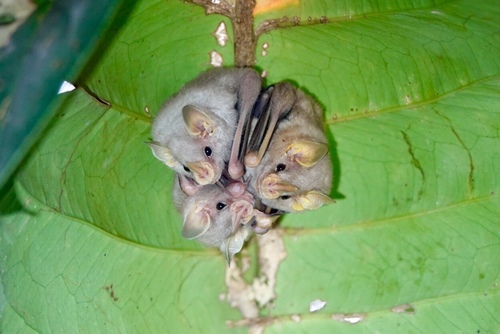
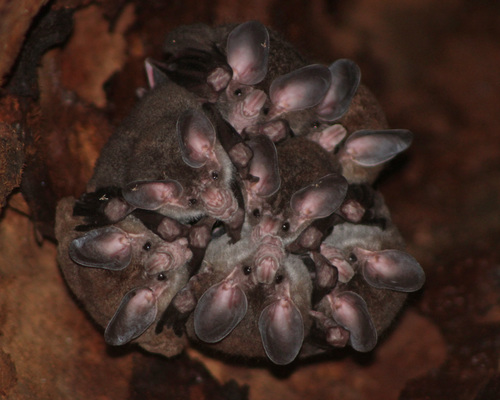
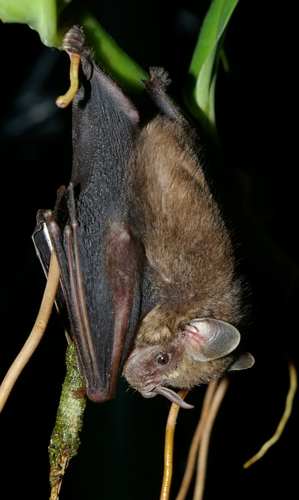
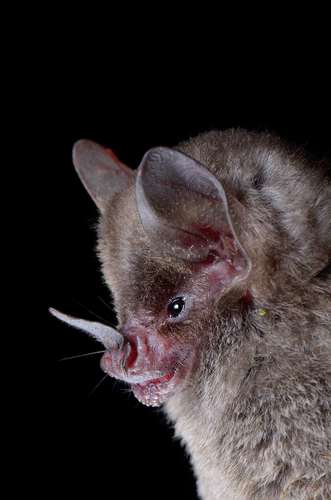
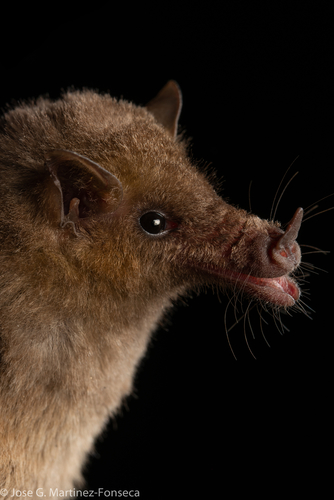
The Mexican long-tongued bat (Choeronycteris mexicana Tschudi, 1844) is a medium-sized species in the leaf-nosed bat family Phyllostomidae. Its fur can grow up to 7 mm long, and is typically gray to brownish, often paler on the shoulders. Its wings are darker brownish gray with paler tips, and its ears match the body’s coloration and vary in size. This bat has a short tail. Adult body weight ranges from 10 to 20 grams, and pregnant females may reach a maximum weight of 25 grams. This species has a distinctly elongated snout, tipped with a nose-leaf that is roughly 5 mm long. Its long, narrow, extendible tongue is specialized for nectar feeding; it is covered in tiny hairlike papillae that become increasingly horny toward the base of the tongue. Its skull can grow up to 30 mm long, with the rostrum making up 40 to 50% of the total skull length. Juveniles have 22 deciduous teeth, which are replaced by 30 permanent adult teeth. Like all microbats (microchiroptera), Mexican long-tongued bats use echolocation. They are especially sensitive to high frequencies between 65 and 80 kHz, but have also been observed responding to lower frequencies around 5 kHz. In the United States, this species occurs in southern California, southern New Mexico, southern Arizona, and has also been recorded in Texas. Further south, its range extends from Mexico (including Baja California and the Tres Marias Islands) through Guatemala, El Salvador, and Honduras. It inhabits areas at altitudes between 300 and 2,629 meters, found in deciduous forest, semi-arid thorn scrub, and mixed oak-conifer forest. Populations in the northern part of the species' range migrate south for the winter.