About Chlorurus microrhinos (Bleeker, 1854)
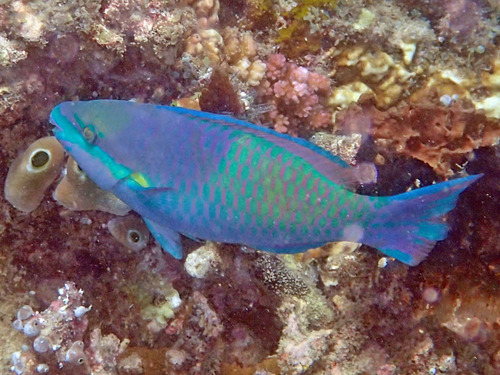
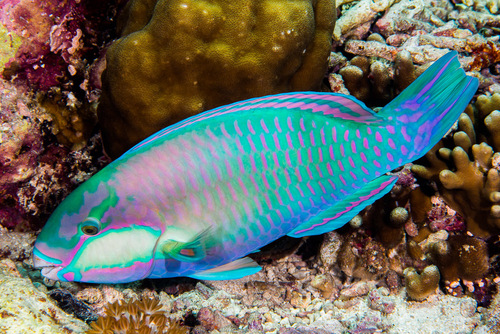
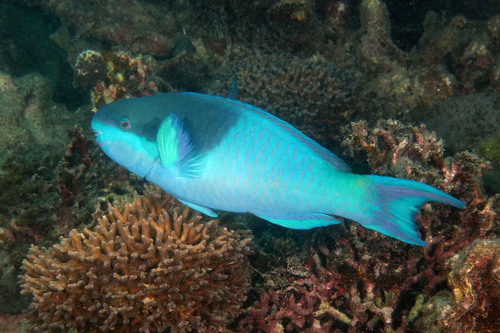
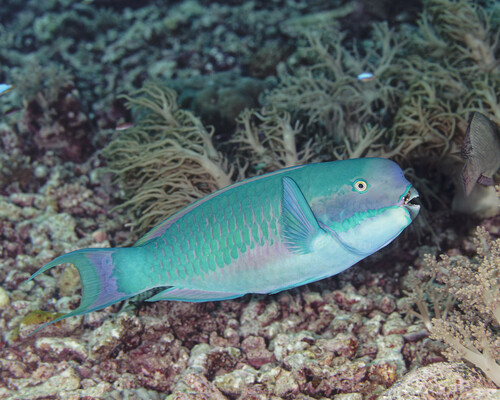
Chlorurus microrhinos typically reaches around 80 centimetres (31 inches) in length. Most individuals of this parrotfish species are greenish blue, with a bright blue band behind the corner of the mouth and a wide blue patch along the head. Rarely, some individuals may be uniformly yellowish-tan. An irregular line crosses the cheek, and the area below this line is usually greenish-yellow. Larger fish are uniformly dark greenish brown, and only turn greenish blue as they age. Unlike other parrotfish (scarids), they do not experience as dramatic a color change as they grow. This species has nine dorsal spines, 10 dorsal soft rays, 3 anal spines, and 9 anal soft rays. Large terminal males have a crescent-shaped tail, while juvenile fish have rounded tails. Adults have large exposed blue-green tooth plates, with one or two canines on each side of the upper tooth plate. Large males develop a prominent forehead, which gives the species its common name of blunt-head parrotfish. Juveniles are black with several horizontal white stripes. Geographic variation exists between populations from the Red Sea, Western Indian Ocean, and Pacific; an unusual reddish-tan color phase occurs in the central Pacific. This species is one of the most widely distributed parrotfish. It is found in the extreme eastern Indian Ocean and the Pacific Ocean, ranging from the Ryukyu and Ogasawara Islands to Indonesia, Australia's Great Barrier Reef, Lord Howe Island, New Caledonia, and French Polynesia, and extending eastwards to Oceania, excluding Hawaii and Easter Island. Chlorurus microrhinos inhabits a range of habitats including lagoons, inshore reefs, and ocean reef fronts, at depths from 2 to 50 metres. At Guam, large individuals are rarely seen in shallow water. This species forms schools that forage over algae-rich lagoons and seaward reefs, grazing on filamentous algae. As this large parrotfish grazes, it excavates coral to access algae, giving it an important ecological role on coral reefs. It grows quickly and can live up to 15 years old. These parrotfish feed mainly on benthic algae and material scraped from corals, leaving exposed reef substrate. They usually swim in schools of around 40 fish, though juveniles are generally solitary. The flesh of adult fish may be slightly toxic in some Pacific localities.