About Chlorurus bowersi (Snyder, 1909)
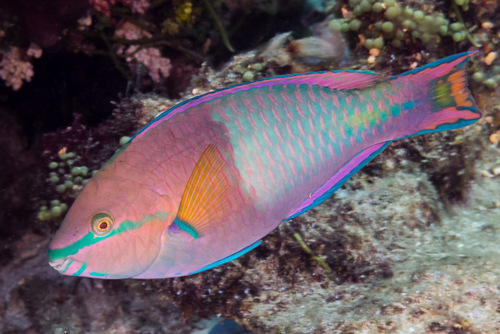
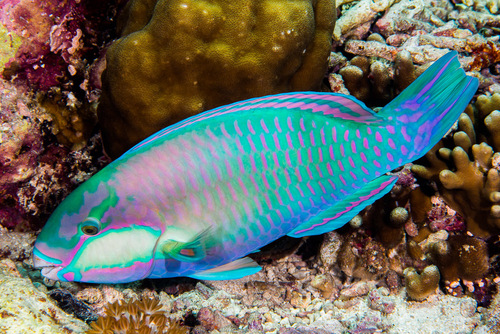
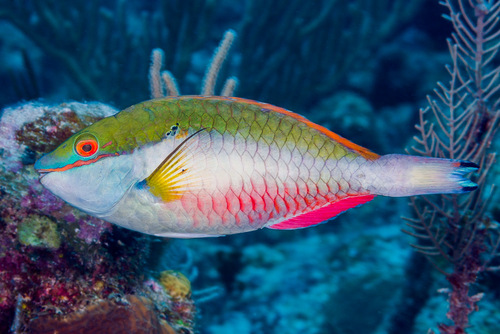
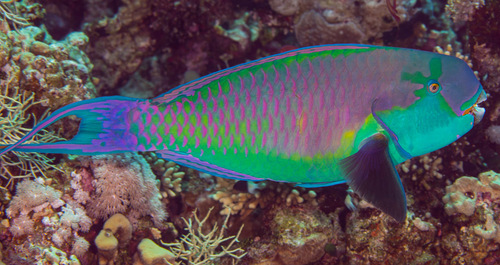
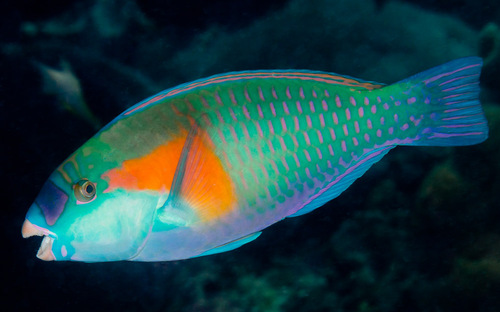
Chlorurus bowersi (Snyder, 1909) has a small, elongated, compressed body and a rounded snout. Its dorsal fin is continuous, with 9 spines and 10 soft rays. The anal fin has 3 spines followed by 9 rays. The pectoral fin has between 13 and 17 rays, and the pelvic fin has 1 spine and 5 rays. Its primary scales are relatively large cycloid scales, and it also has 1 to 4 rows of cheek scales, plus 2 to 8 median predorsal scales. Its interrupted lateral line is made up of 22 to 24 pored scales. C. bowersi is a brightly colored blue-green fish, with orange patches on its head, pectoral fins, and pelvic fins, and orange streaks running along its dorsal and anal fins. Each jaw of C. bowersi holds a well-developed pharyngeal bone and a dental plate. The dental plate forms a beak-like structure that helps the fish feed. Compared to other members of the Labridae family, C. bowersi has a heavier adductor mandible, which gives it greater biting force and more powerful jaw mechanics. Interspecific differences in jaw-lever mechanics and relative adductor mandible weight affect the grazing ability of parrotfish. The teeth of C. bowersi are protrusive, rather than flat. No clear distribution trend for C. bowersi was observed in Okinawa, but the species has been recorded in both inner and exposed reefs there. On Natuna Island, C. bowersi was found in shallow reef areas alongside other parrotfish species. C. bowersi plays an important role in maintaining balance in coral reef ecosystems. Using its beak-like dentition, it scrapes algae off the surfaces of dead coral, preventing excessive algae growth and leaving coral surfaces available for use by other organisms. This scraping also contributes to the bioerosion of coral reefs, a process that is important for the development of reef environments. C. bowersi spawns during high tide. After spawning, individuals remain in the area and feed near the spawning site. Terminal Phase males are territorial and engage in pair spawning with females. To reproduce against territorial Terminal Phase males, smaller Initial Phase males perform a behavior called "streaking", which involves quickly intruding between a spawning pair when they release gametes. C. bowersi primarily participates in pair spawning, but has also been observed engaging in group spawning.