About Chlorostrymon simaethis (Drury, 1773)
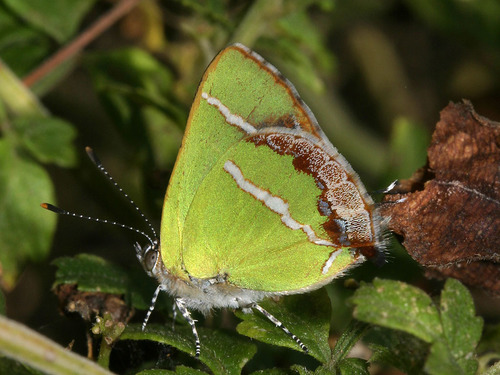
This species, the silver-banded hairstreak, scientifically named Chlorostrymon simaethis (Drury, 1773), has distinct wing coloration by sex. On the upperside of the wings, males have dark, iridescent purple wings. Females are grayish brown, and sometimes have iridescent purple coloring on the basal area of their wings. The underside of the wings is bright lime green for both sexes. Both sets of wings have a bright silvery-white postmedian band. On the hindwing, this silver band juts out toward the margin and turns back inward to form a V shape. Beyond this band sits a dark brownish-red patch with a variable amount of silvery-white frosting, and this frosting extends across the entire edge of the hindwing. Hindwings have one pair of tails, and the total wingspan of this species ranges from 2.2 to 3.2 cm. Silver-banded hairstreaks inhabit subtropical woodlands, deserts, and hammock edges, and only occur in these habitats when their host plants grow nearby. Females lay their shiny green eggs singly on the young fruits of their host plant. Caterpillars live inside the host plant’s seed pod and feed on unripe seeds. Caterpillars range in color from yellowish green to brownish. They have dark, wavy dorsal and subdorsal lines, plus a dark greenish middorsal stripe edged on each side with red ovals. The caterpillar head is tan, and caterpillars turn red just before pupating. The chrysalis ranges in color from tan to grayish brown, with a gray middorsal stripe. It is covered in black and brown spots, and attaches to a surface via a silk pad and girdle. This species produces two or three broods per year.