About Chlorostilbon poortmani (Bourcier, 1843)
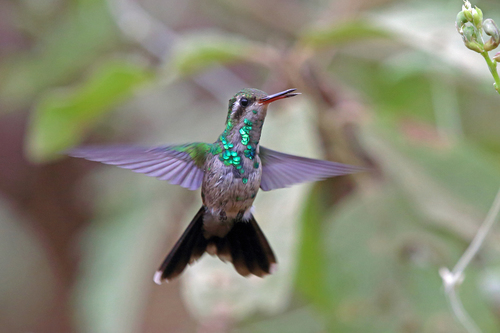
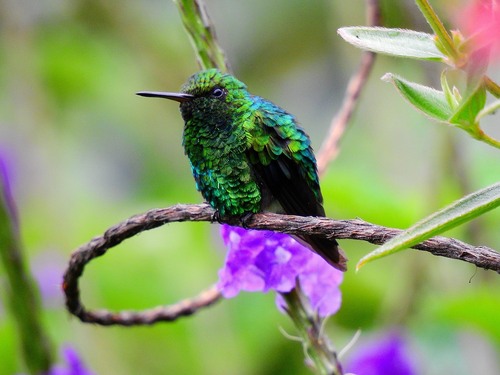
Chlorostilbon poortmani, commonly known as the short-tailed emerald, has two recognized subspecies. Males of the species measure 6.9 to 8.5 cm (2.7 to 3.3 in) in length, while females measure 6.5 to 7.5 cm (2.6 to 3.0 in). Individuals of the species weigh between 3 and 4 g (0.11 and 0.14 oz). Both sexes of both subspecies have a straight black bill. For the nominate subspecies, males have an iridescent green forehead, along with bronzy green crown, upperparts, and uppertail coverts. Their underparts are a brilliant glittery green, and their short, forked tail is iridescent bronze green. Nominate subspecies females have a dull green forehead, and dull bronzy green crown, upperparts, and uppertail coverts. Their underparts are gray, and their tail is also short and forked like the male's. The central pair of tail feathers is green; the other tail feathers have dull turquoise bases that become dark blue near the end, with pale gray tips. Subspecies C. p. euchloris is very similar to the nominate subspecies, but it is slightly larger and has a golden tinge on the crown and underparts. The short-tailed emerald closely resembles many other members of the genus Chlorostilbon. A few other species in this genus have similarly short tails, including the green-tailed emerald. Female short-tailed emeralds are quite similar to females of the coppery emerald (C. russatus) and narrow-tailed emerald (C. stenurus), but those two species have no blue in their tails. The nominate subspecies of short-tailed emerald is distributed from the Andes of western Venezuela's Mérida and Táchira states, along the eastern slope of Colombia's eastern Andes between Boyacá Department and Meta Department. Subspecies C. p. euchloris is found in the eastern Andes of Colombia, occurring on the western slope as far south as Huila Department and on the eastern slope in Santander Department. This species inhabits the interior and edges of humid forest, open woodland, and secondary forest. It also lives in human-created habitats including coffee and banana plantations, and pastures with trees; in pastures, it typically stays near streams. In terms of elevation, it is usually found between 750 and 2,200 m (2,500 and 7,200 ft), but has been recorded as low as 150 m (490 ft) in Mérida and as high as 2,800 m (9,200 ft) in Táchira.