About Chlorostilbon mellisugus (Linnaeus, 1758)
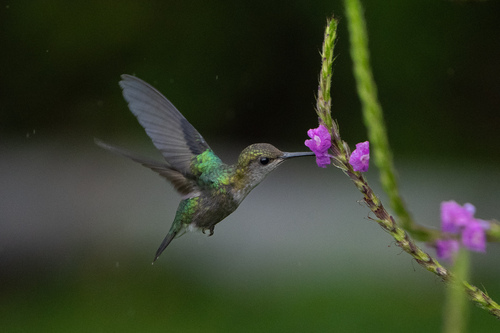
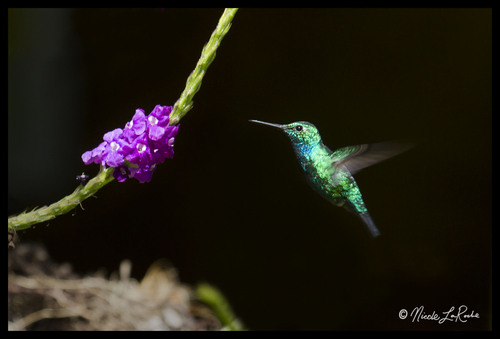
The blue-tailed emerald, Chlorostilbon mellisugus, has distinct size differences between males and females. Males range in length from 7.5 to 9.5 cm (3.0 to 3.7 in), while females are 6.5 to 7.5 cm (2.6 to 3.0 in) long. For two commonly recognized subspecies, the average weights are consistent: males of both C. m. caribaeus and C. m. phoeopygus average about 2.7 g (0.095 oz), while females of C. m. caribaeus average 2.5 g (0.088 oz) and females of C. m. phoeopygus average 2.4 g (0.085 oz). Across all subspecies, both sexes share a short, straight, black bill. All males have a forked tail, with fork depth varying slightly between subspecies, and females of all subspecies are essentially indistinguishable from one another. The nominate subspecies (C. m. mellisugus) males have an iridescent golden green forehead and crown, shining bronze-green upperparts, a steel blue tail, and glittering emerald green underparts that are most iridescent on the breast and carry a bluish tint on the throat; they also have white thighs. Nominate females have a bronzy green forehead and crown, a blackish facial "mask" with a pale gray stripe behind the eye, metallic grass green upperparts, a blue-black tail with whitish gray tips, and pale gray underparts. C. m. caribaeus is very similar to the nominate, but males have less blue on the throat. Male C. m. duidaes have a bronzy orange head and reddish copper upperparts. Male C. m. subfurcatus have blue-green throats and uppertail coverts and golden green crowns, with color intensities that fall between those of the nominate and C. m. caribaeus. C. m. phoeopygus has a deeper tail fork than the nominate, and C. m. peruanus looks essentially identical to the nominate. The International Ornithological Congress recognizes seven subspecies of blue-tailed emerald, each with distinct distributions. C. m. caribaeus is found in northern Venezuela, Trinidad, and the ABC Islands. C. m. duidae occurs in the Cerro Duida region of southern Venezuela's Amazonas state. C. m. subfurcatus ranges across eastern and southern Venezuela, Guyana, and the Rio Branco region of northwestern Brazil. The nominate C. m. mellisugus is found in Suriname, French Guiana, and the lower Amazon basin of northeastern Brazil. C. m. phoeopygus occurs along the upper Amazon River and its eastern tributaries in Colombia, Ecuador, and Brazil. C. m. napensis is found along the upper Amazon River in northeastern Peru. C. m. peruanus ranges across southeastern Peru, eastern Bolivia, and possibly extreme southwestern Brazil. This species inhabits a wide range of landscapes from tropical to temperate zones. It occurs most often in semi-open to open areas including savanna, cerrado, cultivated areas, and gardens. It can also be found at the edges of deciduous woodland, in large clearings within terra firme forest, and is common in várzea and floodplain forest in Ecuador. Its elevation range varies by country: in Ecuador it occurs between 750 and 2,600 m (2,500 and 8,500 ft), in Peru it occurs up to 1,200 m (3,900 ft), and in Venezuela it ranges from sea level to about 1,850 m (6,100 ft).