About Chlorostilbon lucidus (Shaw, 1812)
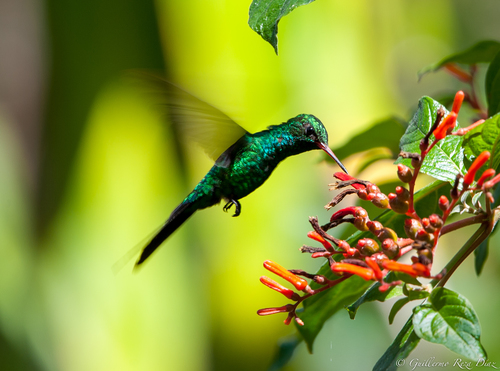
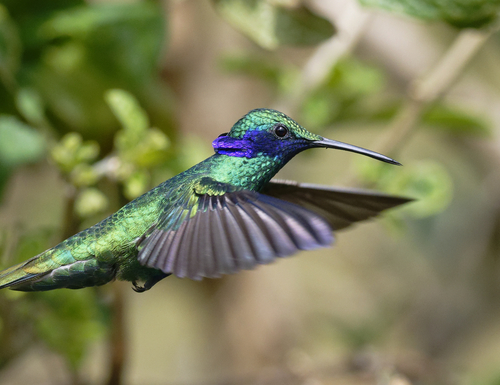
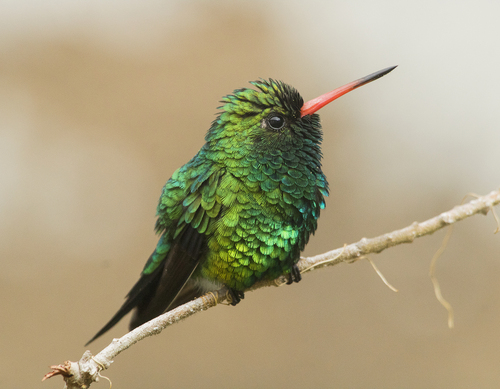
Chlorostilbon lucidus, commonly known as the glittering-bellied emerald, shows distinct size dimorphism between males and females. Males measure 9.5 to 10.5 cm (3.7 to 4.1 in) in length and weigh 3 to 3.8 g (0.11 to 0.13 oz), while females are smaller at 7.5 to 8.5 cm (3.0 to 3.3 in) long and 3 to 4.5 g (0.11 to 0.16 oz) in weight. Both sexes have a short straight bill: the male's bill is red with a black tip, while the female's bill is black on the outer half and red on the inner half. Subspecies of this hummingbird differ slightly in size and plumage. Males of the nominate subspecies C. l. lucidus have a dull bronzy green forehead and crown, slightly golden green upperparts, grass green uppertail coverts, and a slightly forked dark steely blue tail. Their throat and upper breast are blue-green, and their bronze to bronzy green belly is more iridescent than their upperparts. Nominate subspecies females have slightly golden green forehead, crown, and upperparts, with grass green uppertail coverts. The innermost pair of their tail feathers have green inner halves and blue outer halves; the other four pairs are steel blue with gray tips arranged in a V shape. Females have a grayish white streak behind the eye, a whitish throat that darkens to pale brownish gray on the breast and belly. Subspecies C. l. beflepschi has pure green upperparts instead of the nominate's golden green upperparts. C. l. pucherani shares the nominate's plumage but is slightly smaller. When treated as a separate subspecies, C. l. igneous has many glittering orange-gold speckles on its belly. This species has specific vocalizations: its song is a high-pitched, cricket-like trill repeated at intervals. Its main call, given while feeding or hovering, is a short dry, scratchy rattle transcribed as 'trrrr' or 'krrr'. During agonistic encounters, it produces a fast descending series of 'tsee-tsee-tsee-tsu-tsew-tsew-tsew' notes. Different subspecies occupy separate ranges across South America. C. l. pucherani is found in eastern Brazil, from Maranhão and Ceará south all the way to Paraná. The nominate C. l. lucidus occurs in eastern Bolivia, Paraguay, and southwestern Brazil including Mato Grosso. When treated separately from the nominate, C. l. igneous is found in western and northern Argentina. C. l. beflepschi ranges from Rio Grande do Sul in southeastern Brazil through Uruguay into northeastern Argentina, reaching Buenos Aires Province. The species has also been recorded as a vagrant in Chile and Peru. The glittering-bellied emerald lives in a variety of semi-arid to moderately humid, open to semi-open landscapes. It can be found in scrublands, savanna, grasslands, forest edges, parks, and gardens. Its elevation range extends from sea level to 3,500 m (11,500 ft), but it is most common between 500 and 3,500 m (1,600 and 11,500 ft). The species is generally sedentary, though occasional vagrancy outside its core range has been documented.