About Chlorostilbon gibsoni (Fraser, 1840)
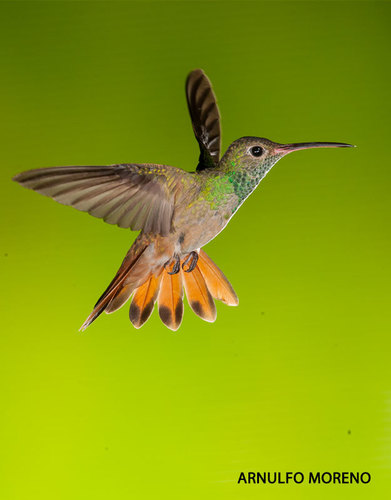
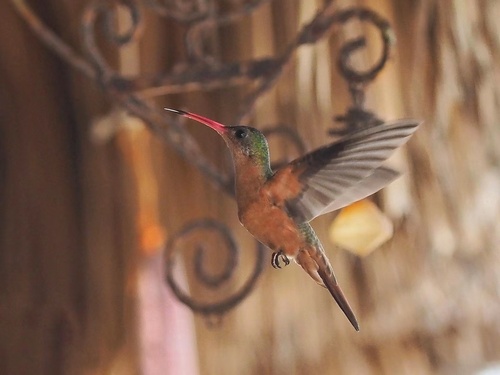
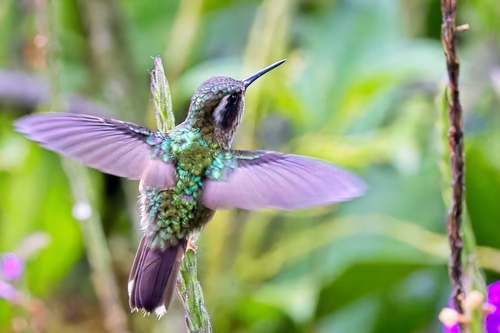
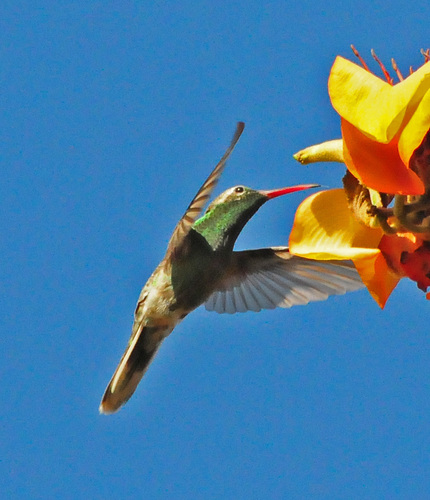
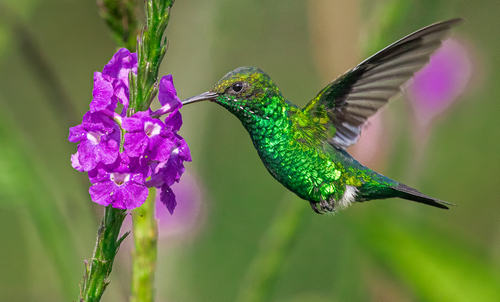
The red-billed emerald, scientific name Chlorostilbon gibsoni (Fraser, 1840), measures 7.6 to 9 cm (3.0 to 3.5 in) in total length and weighs approximately 2.8 g (0.099 oz). All individuals have a bill that is about 1.3 cm (0.51 in) long. Males of all three recognized subspecies have a straight bill with a mostly red mandible, while female mandibles are only red at the base. Males of the nominate subspecies have dark bronze-green upperparts and a deeply forked blue-black tail. Their faces and underparts are glittering green to golden green. Nominate females have shining green upperparts and plain gray underparts, with dusky cheeks and a short white line behind the eye. A female nominate's central tail feathers are dark blue-green, and the remaining tail feathers are dark green with dusky ends and narrow gray-white tips. The subspecies C. g. chrysogaster is larger than the other two subspecies. Males of C. g. chrysogaster are mostly malachite green; their tail is slightly bluer and more deeply forked than the tails of the other subspecies. C. g. nitens is very similar to the nominate subspecies, but it has a slight gold sheen and a less deeply forked tail. The nominate subspecies of red-billed emerald occurs in the Magdalena River valley of central Colombia. C. g. chrysogaster is found in northern Colombia, between the departments of Córdoba and Norte de Santander. C. g. nitens occurs on Colombia's Guajira Peninsula and the adjacent area of northwestern Venezuela. The species inhabits mostly dry to arid landscapes, including desert scrublands, dry woodland, agricultural areas, parks, and gardens. In Colombia, it is mostly found at elevations below 500 m (1,600 ft), but it does occur as high as 2,300 m (7,500 ft) in the upper Magdalena valley. In Venezuela, it has been recorded at elevations up to 1,300 m (4,300 ft).