About Chloropsis sonnerati Jardine & Selby, 1827
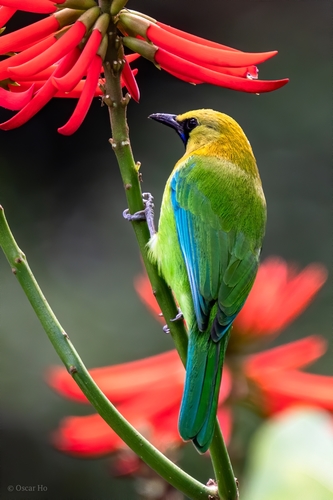
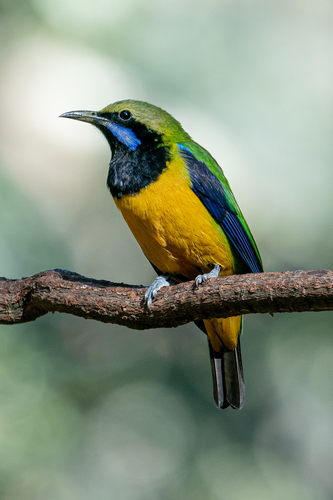
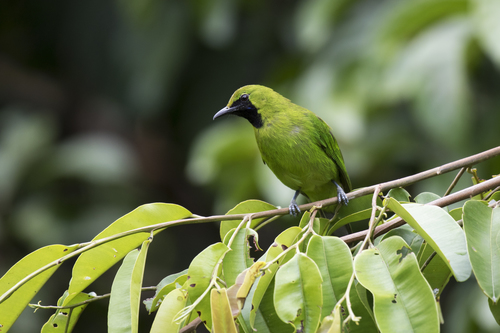
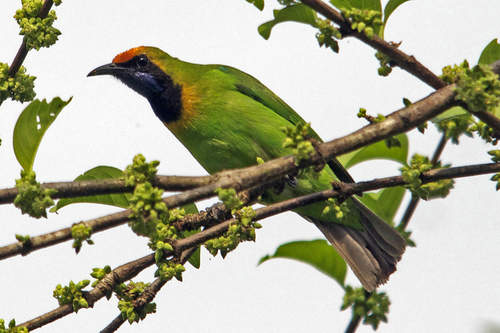
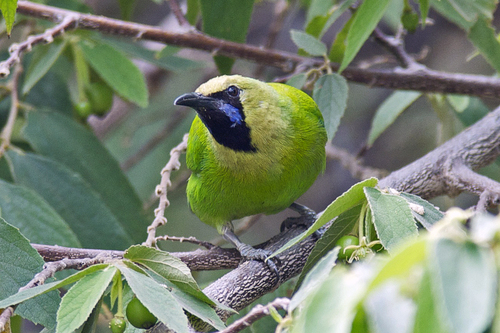
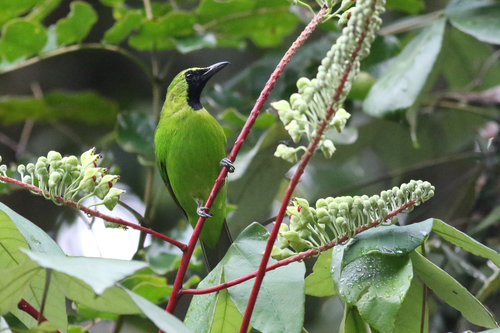
The greater green leafbird, scientifically named Chloropsis sonnerati, is a bird species belonging to the family Chloropseidae. It can be told apart from the lesser green leafbird (Chloropsis cyanopogon) by specific features: females have a powerful beak, a yellow throat, and an eye ring, while males lack the yellow border along the black throat patch that is present in male lesser green leafbirds. This species is distributed across Brunei, Indonesia, Malaysia, Myanmar, Singapore, and Thailand. Within Indonesia, it occurs in Sumatra, Borneo, the Natuna Islands, Java, and Bali. Its natural habitats are subtropical or tropical moist lowland forest and subtropical or tropical mangrove forest. It occurs mainly in old-growth forest, but can also be found in secondary forest and forest edges. It moves quite noticeably at the canopy level, jumping between branches and flying from tree to tree. It often visits fruiting fig trees to feed, and also eats insects and small invertebrates. The greater green leafbird has a loud call, which is an ascending whistle transcribed as chee-zi-chee. This species is threatened by trapping for the cage bird trade, and has become rare, or even entirely disappeared, across large portions of its range.