About Chloropsis aurifrons (Temminck, 1829)
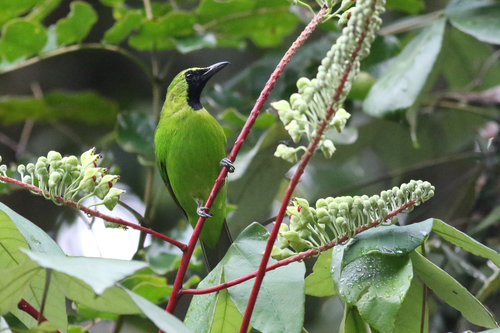
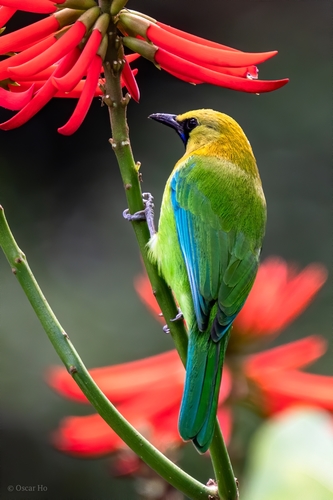
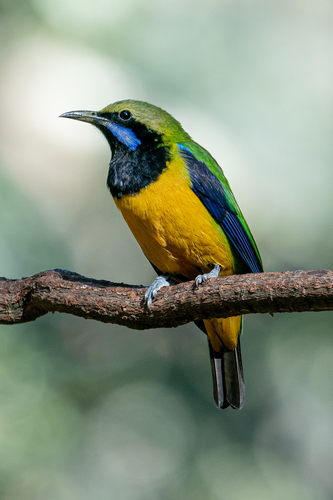
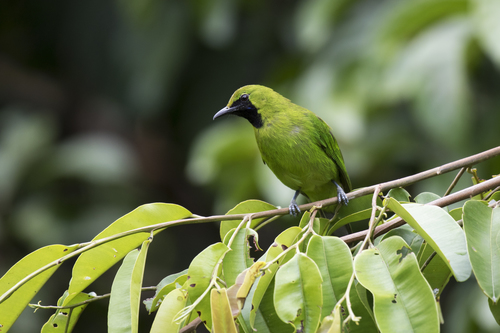
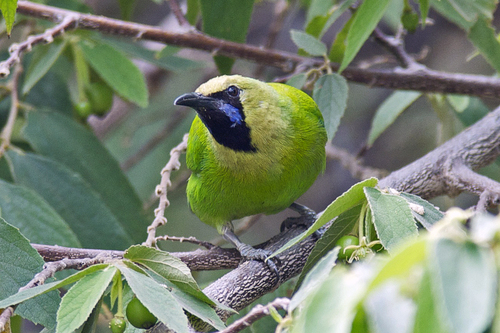
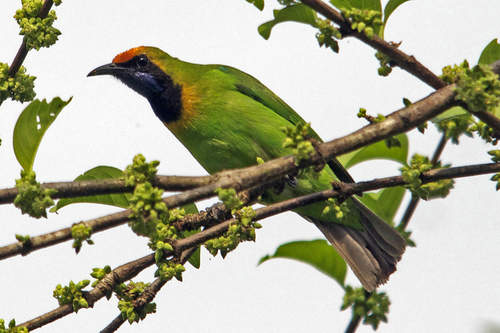
Adult golden-fronted leafbirds (Chloropsis aurifrons) have green bodies, a black face and throat bordered with yellow, dark brown irises, blackish feet and a blackish bill. They have a yellow-orange forehead and a blue moustachial line, but do not have the blue flight feathers and blue tail sides seen in blue-winged leafbirds. Juveniles have a plain green head, and lack the black markings on the face and throat. Females have slightly duller black coloration on the face and throat than males. The southern Indian subspecies C. a. frontalis has a narrower yellow border around the black face, a black throat, a blue sub-moustachial stripe, and a duller orange forehead. The subspecies insularis, found in far southern India and Sri Lanka, is slightly smaller than C. a. frontalis.
This species is a common resident breeding bird found in India, Bangladesh, Sri Lanka, and parts of Southeast Asia. It is widely distributed across India, Bangladesh, Bhutan, Myanmar, Thailand, Cambodia, Laos, Vietnam, and Indonesia. It typically lives in dense forest canopies, deciduous forests, woodlands, and scrublands, and is also frequently found in wooded gardens and plantations.
Golden-fronted leafbirds build their nests in trees and lay clutches of 2 to 3 eggs. Their diet consists of insects, berries, nectar, and spiders. They are highly acrobatic, often clinging upside down to twigs in the canopy to glean prey. They can imitate the calls of many other bird species, including the Tailor-bird, Black Drongo, and Common Iora. Their song is melodic, high-pitched, and whistling, with rising and falling liquid chirps in bulbul-like tones; their call may also include harsh whispers, usually delivered from the top of a tree. They are generally found in pairs or small groups of up to 8 individuals, and sometimes join mixed-species foraging flocks.