About Chloromyia formosa (Scopoli, 1763)
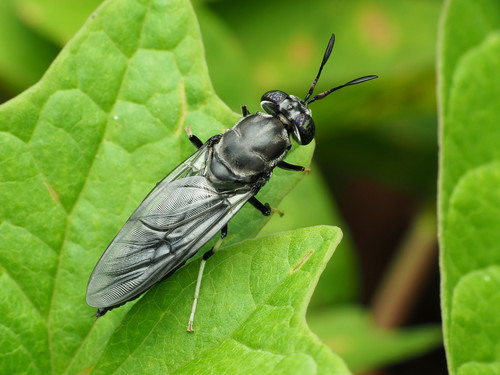
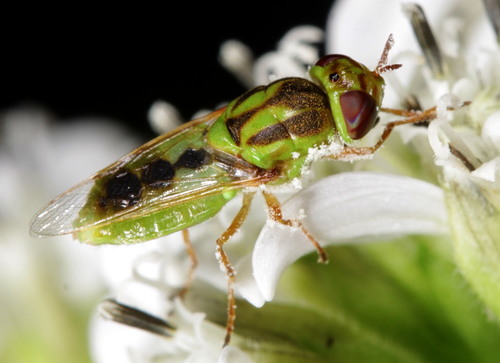
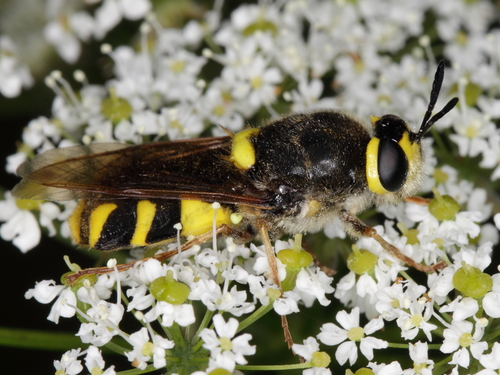
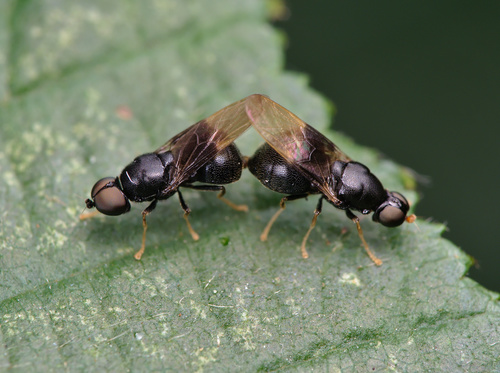
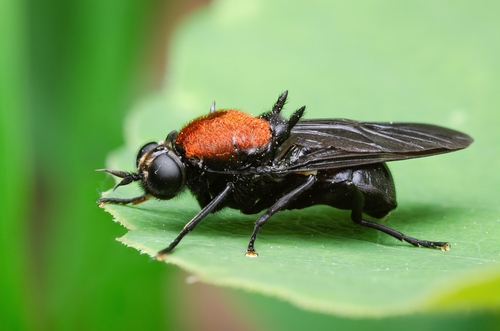
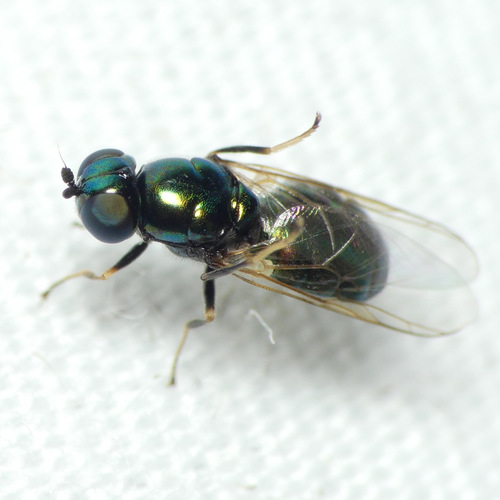
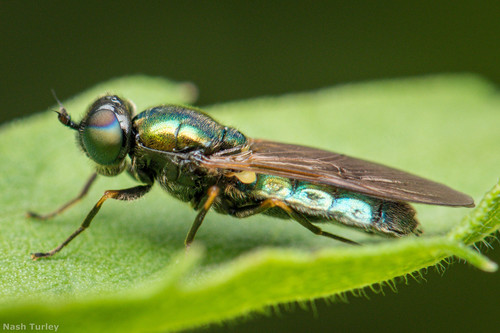
Chloromyia formosa (Scopoli, 1763) reaches an adult body length of 7.3–9 millimetres (0.29–0.35 in) and a wing length of 6–7 millimetres (0.24–0.28 in). This species has an elongated overall body shape, a metallic green thorax, a hairless hemispherical head, and noticeably hairy eyes. Its antennae are short, with the first antennal segment longer than the second. Legs are mostly black, with only the knee segments colored yellow. The abdomen is flattened and broad. Clear sexual dimorphism occurs between males and females of Chloromyia formosa. Females have a blue-green abdomen with a purple sheen that varies with lighting, while males have a copper-green abdominal sheen. Females also have eyes that are separated from one another. The wings of this species are yellowish-brown. This species is distributed across most of Europe, including Austria, Belgium, Bulgaria, the Czech Republic, Denmark, Finland, France, Germany, Greece, Ireland, Italy, Luxembourg, the Netherlands, Norway, Poland, Russia, Spain, Sweden, Switzerland, and the United Kingdom. It also occurs in the Near East, the Nearctic realm, and North Africa. Its preferred habitats are primarily wooded areas, hedge rows, moist forests, wet meadows, parks, and gardens.