About Chlorodrepanis virens (J.F.Gmelin, 1788)
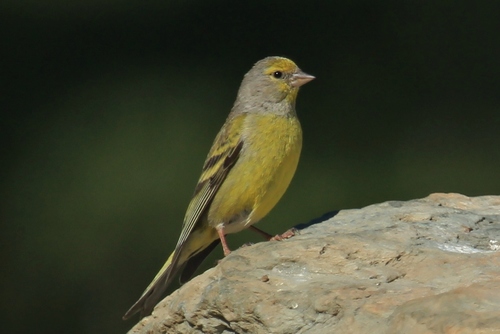
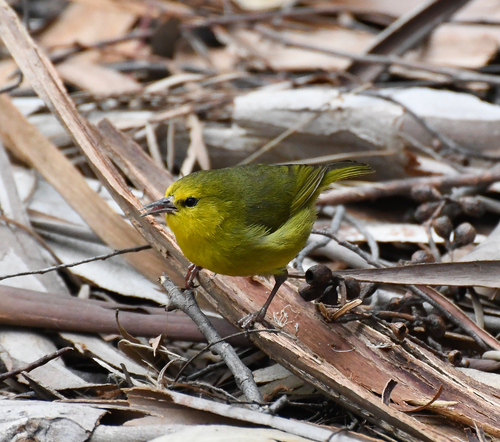
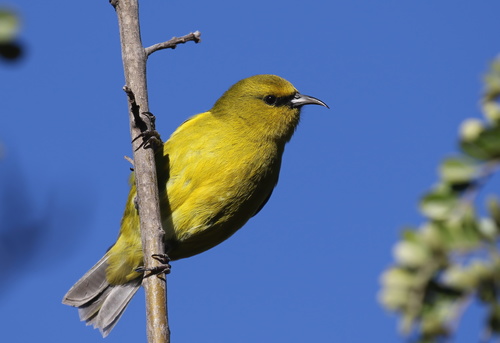
Description: The Hawaiʻi ʻamakihi is a small bird, measuring around 10 centimetres (3.9 in) long. Its plumage is yellow-green, it has a small 1.3 centimetre (0.51 in) long black bill, and brown eyes with black pupils.
Distribution and habitat: This species is found on the Big Island, Maui, and Molokaʻi in Hawaii. It formerly lived on Lānaʻi, where it was last recorded in 1976. It is one of the most common Hawaiian honeycreepers, and inhabits all habitat types on these islands, from dry māmane forests to mesic and wet forests, at elevations ranging from sea level up to 8,000 feet (2,400 m). On Maui, it has also successfully established populations in forests of introduced pines, cypresses, and firs. Among all native Hawaiian forest birds, the Hawaiʻi ʻamakihi has been the least impacted by habitat changes. Researchers suspect it is evolving resistance to diseases like avian malaria. Alongside the ʻApapane, it is one of two Hawaiian honeycreepers classed as Least Concern by the IUCN.
Reproduction: The Hawaiʻi ʻamakihi is a productive species with a long breeding season that lasts approximately 9 months. While the start of the breeding season varies between populations on the Big Island, Maui, and Molokaʻi, it often coincides with the flowering of māmane in dry māmane forests. Hawaiʻi ʻamakihi build their nests in the canopies of trees. They frequently produce two broods within a single breeding season; having two rounds of chicks allows their population to grow more quickly than slower-growing species like the endangered Kiwikiu. Chicks stay in the nest for 15 to 21 days before fledging. Young Hawaiʻi ʻamakihi become independent of their parents at 2 to 3 months old.