About Chloroceryle inda (Linnaeus, 1766)
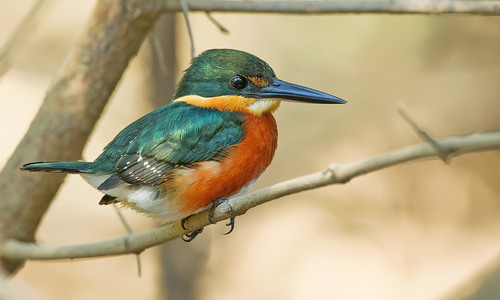
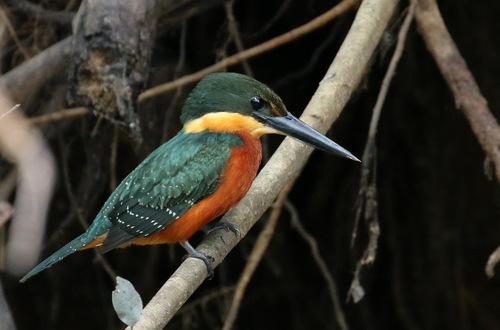
Description: The green-and-rufous kingfisher is about 24 cm (9.4 in) long. Males weigh 40 to 60 g (1.4 to 2.1 oz), while females weigh 53 to 62 g (1.9 to 2.2 oz). It has the typical kingfisher shape, with a somewhat shaggy crest and a long, heavy bill. The bill is black with some pale yellow at the base of the mandible, and its legs and feet are pinkish to dark gray. The two subspecies have almost identical plumage, and the differences between them are similar to the variation present within each individual subspecies. Adult males have glossy green upperparts with a pale yellowish collar. Their upperwing coverts have white tips, and their secondaries, tertials, and tail have small white spots. Their chin is yellow-buff, their throat is buffy rufous, and the rest of their underparts are a rich dark rufous. Adult females are similar to males, with the addition of a wide band of green with white speckles across their upper breast, and more pale spotting on their upperparts. Juveniles resemble adult females, with even heavier spotting on the upperparts. Both sexes of juveniles have a green breastband, although the male's is thin. Distribution and habitat: The nominate subspecies of the green-and-rufous kingfisher has the far larger range of the two subspecies, split into three separate parts. The first part extends from southeastern Nicaragua through the Caribbean slope of Costa Rica and across most of Panama into Colombia. The second extends from eastern Colombia east through Venezuela and the Guianas into eastern Brazil, and south through most of Amazonian Brazil, Ecuador, Peru, Bolivia, and Paraguay. The third section of the range is along a narrow strip of southeastern Brazil, running from Bahia south to Santa Catarina. Subspecies C. i. chocoensis is found in western Colombia and northwestern Ecuador. There is one undocumented sight record of the species in Argentina, which leads the South American Classification Committee of the American Ornithological Society to class the species as hypothetical in that country. The green-and-rufous kingfisher inhabits streams and rivers, forested swamps, and mangroves. It favors densely vegetated banks and shuns open shorelines. In elevation, it ranges from sea level to 400 m (1,300 ft).