About Chloroceryle americana (J.F.Gmelin, 1788)
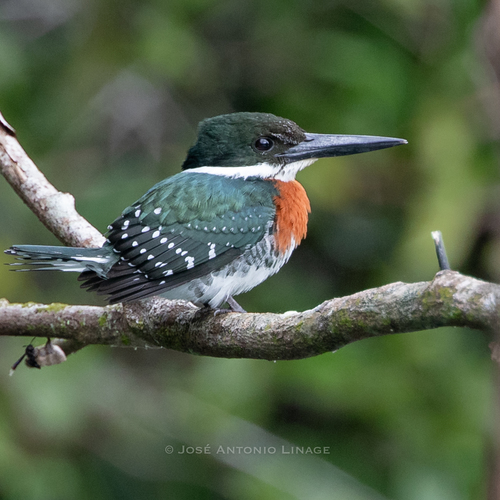
The green kingfisher, Chloroceryle americana, is about 20 cm (8 in) long and weighs 35 to 40 g (1.2 to 1.4 oz), with females larger and heavier than males. Individuals from the northern and southern extremes of the species' range, and those west of the Andes, are larger and heavier than other populations, and this difference follows a clinal pattern. The species has the characteristic shape of a kingfisher, with a long, heavy bill that is largest and heaviest in individuals from Trinidad and Tobago. Unlike many other kingfisher species, it does not have a prominent crest. Its bill is black, with a horn-like coloration at the base of the lower mandible, and its legs and feet are dark gray. Both sexes have green upperparts, with two or more rows of white spots on the flight feathers. Most of their underparts are white, with green spots on the sides of the body and flanks. Their tail is green, with extensive white markings on the outer feathers that are most visible when the bird is in flight. Adult males have a white collar and a rufous-colored breast. Adult females also have a white collar, but their throat and breast are buffy, and they have a band of green speckles across the breast and upper belly. Juvenile green kingfishers look similar to females, but their plumage is duller, and they have small buff spots on their crown and wing coverts. One of the species' vocalizations resembles the sound of two pebbles striking together, and it is usually given as a single or double note. A second vocalization is a harsh, buzzing scold, described by different authors with transcriptions including tsheersh, tseelp, or zchrrk. Authors disagree on whether these vocalizations count as calls or songs, and if they are calls, there is no consensus on their function. Subspecies of green kingfisher differ slightly in the shade of green on their upperparts, the amount of white on the wings and tail, the amount and size of flank markings, and whether the breast band is complete. However, there is extensive individual variation within each subspecies, and many of the differences between populations are clinal, so the distinctions between subspecies are often obscured. The green kingfisher lives on wooded shorelines of streams, freshwater ponds, and lakes. It prefers still or slow-moving water. While it needs low vegetation to use as hunting perches, it generally favors relatively open habitat over dense forest. It remains a year-round resident across its entire range, but it roams a territory that can cover 1 km (0.6 mi) or more of river.