About Chloroceryle amazona (Latham, 1790)
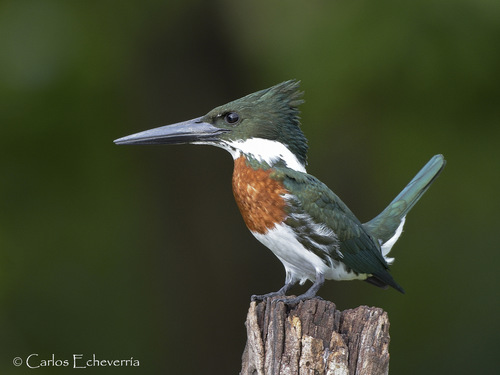
The Amazon kingfisher (Chloroceryle amazona (Latham, 1790)) reaches approximately 30 cm (12 in) in total length. Males weigh between 98 and 121 g (3.5 to 4.3 oz), while females are heavier at 125 to 140 g (4.4 to 4.9 oz). It has the characteristic shape of a kingfisher, with a shaggy crest and a long, heavy bill. The bill is black with a small area of pale yellow at the base of the lower mandible, and its legs and feet are dark gray. Adult males have dark bronzy green upperparts, separated from the head by a distinct white collar. They have white coloring on the chin and throat, a rich rufous breast with dark green on the sides, and a white belly marked with dark green streaks along the sides. Adult females do not have the rufous breast; instead, the green coloring from the sides extends across the breast almost to its center. Juvenile males have a buffy rufous breast, and juveniles of both sexes have buff spots on the upperwing coverts and a large yellow patch on the bill. The Amazon kingfisher has two separate distribution segments. Its range starts from the Mexican states of Sinaloa and Tamaulipas, extending south through Central America into Colombia and Venezuela. The second segment lies east of the Andes, covering every South American country except Chile and reaching as far south as central Argentina. It has been recorded as a vagrant in Aruba, Trinidad, and the US state of Texas. This kingfisher inhabits large slow- and fast-flowing rivers, as well as wooded shores of lakes and freshwater lagoons. It occasionally occurs in brackish lagoons, mangroves, and tidal estuaries. It prefers open landscapes over dense forest. Most individuals are found below 1,200 m (3,900 ft) in elevation, but the species has been recorded as high as 2,500 m (8,200 ft) in Venezuela.