About Chloroceryle aenea (Pallas, 1764)
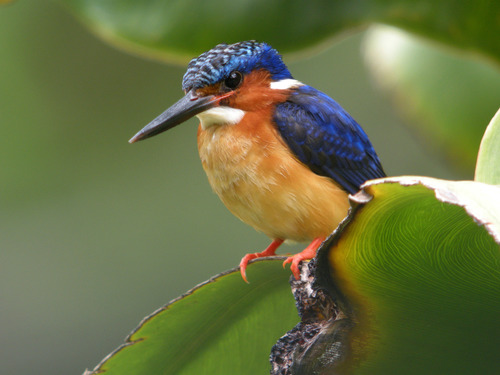
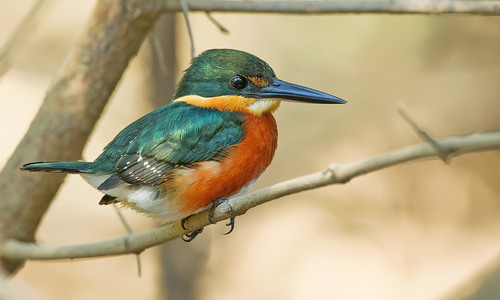
The American pygmy kingfisher, Chloroceryle aenea, measures approximately 13 cm (5.1 in) in length. Males weigh 10 to 16 g (0.35 to 0.56 oz), while females weigh 12 to 16 g (0.42 to 0.56 oz). It has the characteristic shape of a kingfisher: a shaggy crest and a long, heavy bill. The bill is black, with pale yellow coloring at the base of the lower mandible, and its legs and feet are pinkish to light gray. Males of the nominate subspecies have dark glossy green heads and upperparts with a golden wash, separated by a narrow rufous collar. Their tails are a bluer shade of green. They have black lores, with a thin rufous line in front of the eye. Their chin, throat, and most of their underparts are rufous, with a deeper shade on the breast and flanks. The center of the breast and the undertail coverts are white. Adult females are similar to males, with the addition of a dark green band across the upper breast. Juveniles have paler underparts than adults and buffy spots on the wings; juvenile males have green-black streaks on the breast, and juvenile females' breast band is often incomplete. The subspecies C. a. stictoptera has distinct lines of white spots on its secondaries and some white coloring on the rump. These two subspecies intergrade in central Costa Rica. Of the two recognized subspecies of the American pygmy kingfisher, C. a. stictoptera is the more northerly one. It occurs from the southern Mexican states of Puebla, Veracruz, Yucatán, and Chiapas, south through Belize, Guatemala, El Salvador, Honduras, and Nicaragua to central Costa Rica. The nominate subspecies is found from central Costa Rica, where it overlaps with C. a. stictoptera, through Panama into Colombia. From Colombia, its range extends west of the Andes to central Ecuador, and east and south into Venezuela, the Guianas, and most of Amazonian Colombia, Brazil, Peru, and Bolivia. Its range extends a small distance into Paraguay and Argentina, and also includes the island of Trinidad. The American pygmy kingfisher lives in dense forest, where it occurs along small streams and rivers, beside pools, in swamps, and along tidal channels in mangroves. It avoids open landscapes. In terms of elevation, its range spans from sea level up to 2,600 m (8,500 ft).