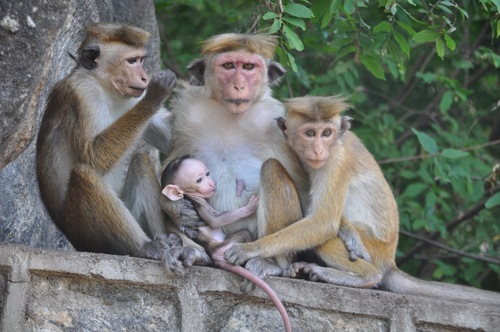
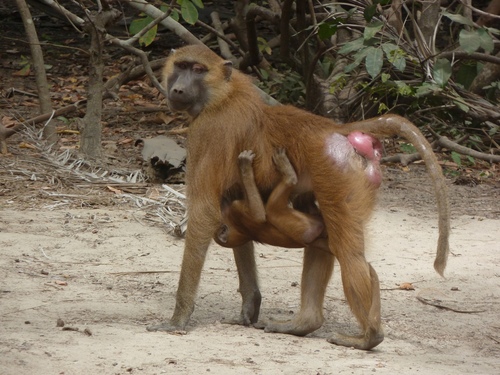
About Chlorocebus sabaeus (Linnaeus, 1766)
Chlorocebus sabaeus, commonly called the green monkey, is a sexually dimorphic species, with males typically being slightly larger than females. Wild adult males weigh between 3.9 and 8.0 kg (8.6 and 17.6 lb) and measure between 420 and 600 mm (1.38 and 1.97 ft), while wild adult females usually weigh between 3.4 and 5.3 kg (7.5 and 11.7 lb) and measure between 300 and 495 mm (0.984 and 1.624 ft).
Green monkeys occupy a wide range of wooded habitats, from very dry Sahel woodland to the edge of rainforests. They are also commonly found in coastal regions, where they feed on seashore foods such as crabs. They eat a wide variety of other foods as well, including fruits and invertebrates.
The native range of the green monkey is West Africa, extending from Senegal and The Gambia to the Volta River. There is a native insular population on the Bijagós Islands in Guinea-Bissau. The species was introduced to the Cape Verde islands off north-western Africa (only the islands of Santiago and Brava) as early as the second half of the 16th century, and to the West Indian islands of Saint Kitts, Nevis, Saint Martin, and Barbados in the late 17th century, brought by slave ships traveling from West Africa. A small colony descended from 20th century zoo escapees currently exists in Broward County, Florida.
Green monkeys live in a polygynous social structure centered on alpha males, who control social interactions and mating between other group members. They are seasonal breeders, with breeding occurring from April to June in most ranges (October and November in the Nyes area, North West of Thies) when rainfall is heaviest. Because fruit is most abundant during these rainy seasons, it has been speculated that green monkeys time their breeding to align with this period of abundant resources. They breed approximately once a year. Males reach sexual maturity at five years old, while females reach sexual maturity at two years old. Although infant mortality is fairly high, at roughly 57%, green monkeys invest heavily in their offspring. Mothers care for their young for about a year before the young become independent adult individuals.