About Chlorestes eliciae (Bourcier & Mulsant, 1846)
Chlorestes eliciae, also called the blue-throated goldentail, is a medium-sized hummingbird. Adults measure 9 cm (3.5 in) long and weigh 3.6 g (0.13 oz) on average. For males, average wing length is 49.7 mm (1.96 in), average tail length is 26.7 mm (1.05 in), and average culmen length (measured from the base of the bill) is 18.2 mm (0.72 in). Females are slightly smaller than males, with an average wing length of 47.7 mm (1.88 in) and average tail length of 25.9 mm (1.02 in), but have a longer average bill at 19.4 mm (0.76 in).
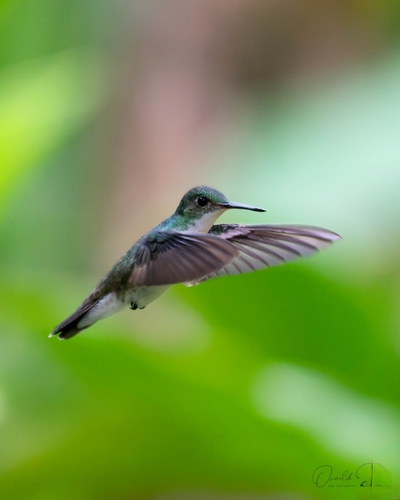
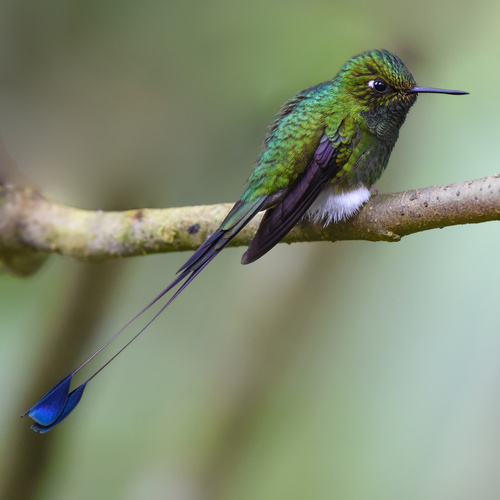
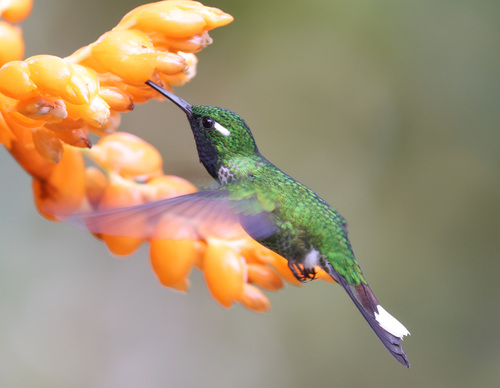
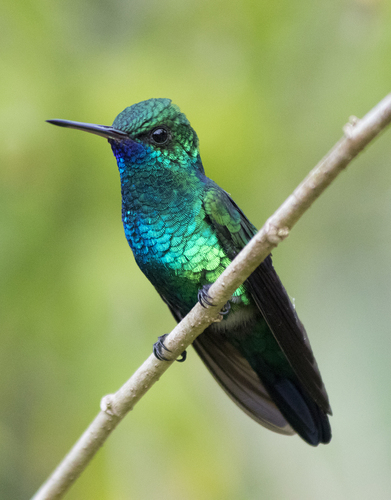
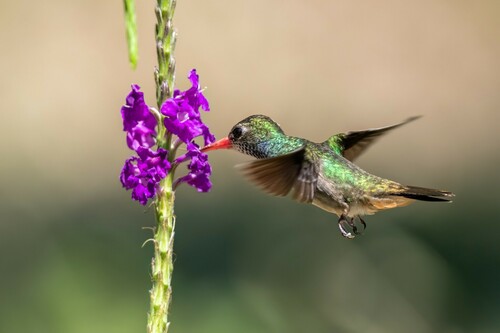
Adults of this species have green crowns and upperparts, which transition to a metallic golden-green tail. Their wings are dusky, and their sides and belly are green. The throat is metallic blue-violet. The bill is straight, broad at the base, and coral red with a black tip. Females are paler overall than males, have more black on the bill and more grey on the throat, but still have bright golden-green upper tail coverts. Both male and female blue-throated goldentails have dark brown irises and toes.
After hatching, juvenile birds complete their preformative plumage between March and August. They develop their definitive prebasic plumage during the March–August period of the following year. During the first year after hatching, female juveniles undergo distinct plumage and bill changes: their initially blackish culmen fades to a dusky color with red wash covering 50% of the bill base, their throat's original greenish-blue spotting becomes more extensive dark-blue spotting, and the cinnamon tips on their outer rectrices vanish as their plumage matures. Male juveniles develop differently: their culmen changes from dusky with partial red coloration to bright red on 75% of the bill base, their throat's dark-blue spotting grows larger, and the gray edges on their feathers fade. Unlike female juveniles, male juveniles never have cinnamon tips on outer rectrices, and their black bill tip contrasts far more with their bright red bill base than the contrast seen in female juveniles.
Blue-throated goldentail can sometimes be confused with the rufous-tailed hummingbird, but the rufous-tailed hummingbird is larger, has a longer rufous tail, a green throat and breast (unlike the blue-throated goldentail's blue throat), and a more curved, paler bill. It also resembles the blue-headed sapphire, which differs by having a blue crown and blue sides of the head, a green throat, and a blue tail. The ranges of blue-throated goldentail and blue-headed sapphire overlap in extreme eastern Panama and northwestern Colombia, but there is no evidence the two species occur sympatrically.
Male blue-throated goldentails sing in leks. Their song varies greatly between different leks, and less commonly varies within a single lek. The song is typically a phrase of 5 to 8 notes: the first note is a piercing tseee, followed by a series of single notes, double notes, or short trills. A male usually gives 1 to 3 of these phrases, pauses, then repeats. Recorded examples include seee; sa se sa se sase; tseet twosip twosip twosip; and zeee wrrr zewet zewet zewet. The call of the blue-throated goldentail is described as a high, buzzy tzip or tzet; the aggressive call is a sharp, liquid, descending twitter. No nonvocal sounds have been documented other than the whirring or humming sound produced by wing flapping.
The blue-throated goldentail is endemic to the Americas. Its range extends from southern Mexico to western Panama along both the Pacific and Atlantic slopes, with a few recorded occurrences in northern Chocó, Colombia. It occupies lowlands and valleys, with a typical maximum elevational range of 950 m above sea level in Costa Rica and 1000 m above sea level in Mexico. However, some specimens have been recorded as high as 2000 m above sea level in Braulio National Park, Costa Rica, and in El Salvador.
Seasonal movements of the blue-throated goldentail are poorly documented. It is considered resident throughout most of its range and is generally sedentary, though it may wander locally during flowering seasons. Researchers have suggested that these unusual high-elevation records could be a result of climate change: as high-elevation bird species decline in abundance, lower-elevation species like the blue-throated goldentail have started moving to higher elevations. The species' natural habitats include humid to semihumid forest, second-growth forest, plantations, semi-open areas, light woodland, gardens, and gallery forest in drier regions.