About Chlorestes candida (Bourcier & Mulsant, 1846)
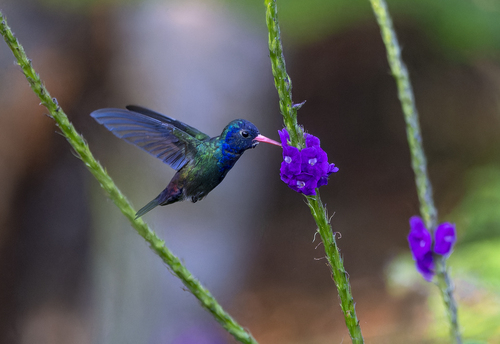
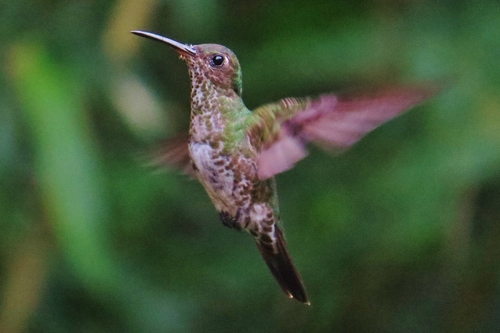
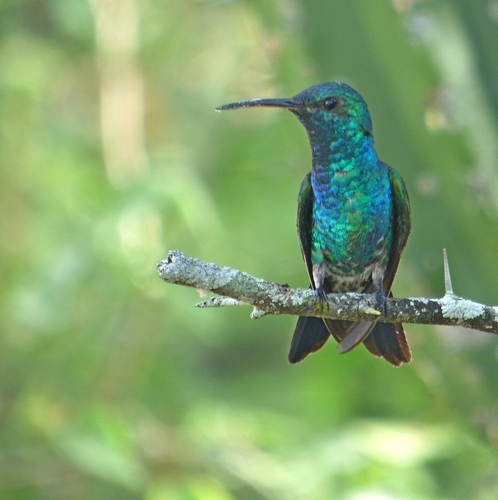
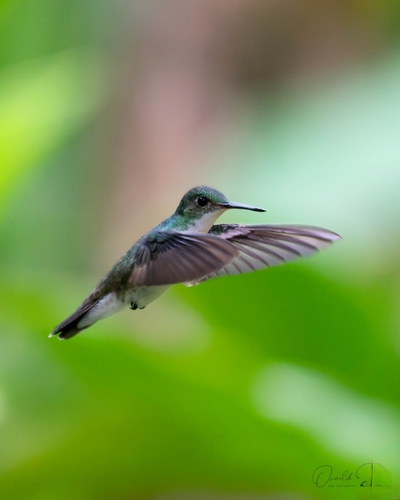
The white-bellied emerald (Chlorestes candida) has three recognized subspecies. The nominate subspecies measures 8 to 11 cm (3.1 to 4.3 in) long and weighs 2.9 to 4.3 g (0.10 to 0.15 oz). The upperparts of adult nominate birds are metallic bronze to bronzy green, with the back typically a greener shade than the crown and neck. Their underparts are white, with metallic bronzy green extending from the cheeks through the flanks. The tail is metallic bronze; all feather pairs except the central two have a broad purplish bronze or blackish band near the tip, and the outermost two feather pairs also have dull brownish gray tips. Immature birds resemble adults, but the feathers of their crown, rump, and uppertail coverts have brownish tips. Subspecies C. c. genini differs from the nominate subspecies only in having a longer and broader bill. Subspecies C. c. pacifica has a heavier, stouter bill than the nominate, and the green color of its back extends further onto the bird’s sides and flanks. The nominate subspecies occurs on the Caribbean slope, from the Mexican states of Chiapas, Tabasco, and Yucatán south through Belize, Guatemala, and Honduras into Nicaragua. C. c. genini is found in southeastern Mexico, north of the range of the nominate subspecies, between San Luis Potosi and northern Oaxaca. C. c. pacifica occurs on the Pacific slope of Mexico in extreme southern Chiapas, and is also found disjunctly in Guatemala. Specimens of this species were collected in Costa Rica in the late 19th and early 20th centuries, but no recent records of the species exist there. The white-bellied emerald lives in the interior and edges of lowland evergreen and semi-deciduous forest. It ranges in elevation from sea level up to 1,600 m (5,200 ft).