About Chlidonias hybrida (Pallas, 1811)
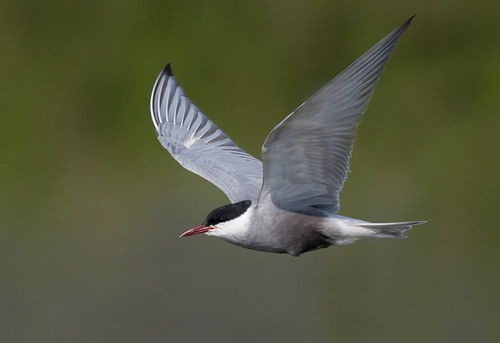
This species, the whiskered tern, has a size, black cap, strong bill, and more active flight that recall common or Arctic terns, but its short, forked-looking tail and dark grey breeding plumage on both upper and lower body are typical characteristics of marsh terns. For the bill, males have bills measuring 29–34 mm, while females have stubbier bills measuring 25–27 mm, all with a pronounced gonys. Summer adults have white cheeks, red legs, and a red bill. Juveniles have crowns flecked with white and a more uniformly blackish hindcrown; winter adults also have hindcrowns flecked with white. The black ear-coverts connect to the black of the hindcrown, and the space above this connection is mottled with white, creating the appearance of a C-shaped black band. The sides of the neck are white, and this white color sometimes extends all the way across the nape. The neck collar is less sharply defined. The rump is pale grey year-round. Juveniles have a variegated pattern on the mantle. Their back and scapular feathers are dark brown, with prominent broad buff edgings and often subterminal buff bars or buff centers. Usually, an admixture of new gray feathers, especially on the mantle, appears quite early in the fall. Adult whiskered terns have a silvery-grey mantle. The species' characteristic call is a krekk. In winter, the forehead turns white and the body plumage becomes much paler grey. Juvenile whiskered terns have a ginger scaly back, and otherwise closely resemble winter adults. First winter plumage is intermediate between juvenile and adult winter plumage, with patchy ginger coloring on the back. Whiskered terns feed on small fish, amphibians, insects, and crustaceans.