About Chlamys hastata (G.B.Sowerby II, 1842)
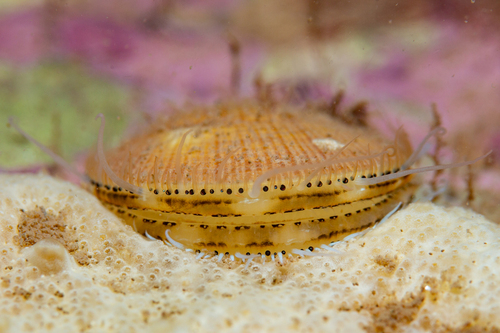
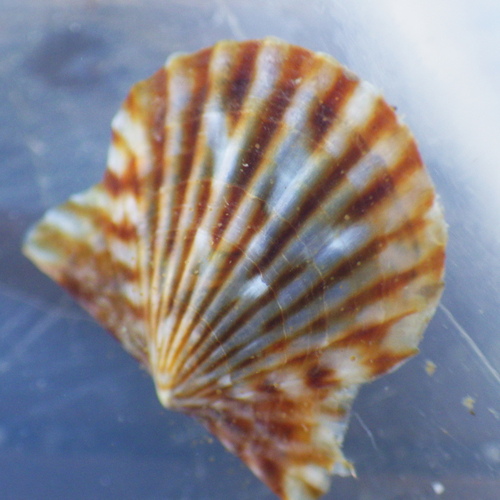
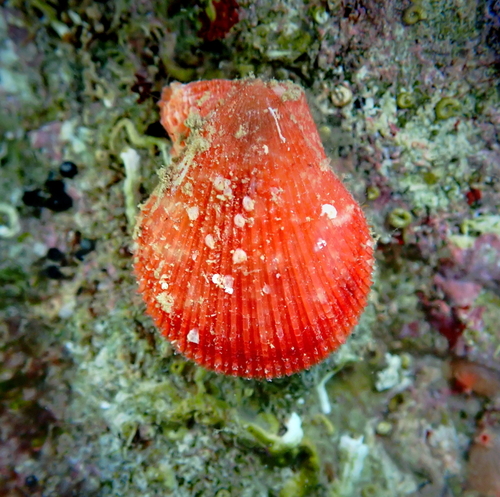
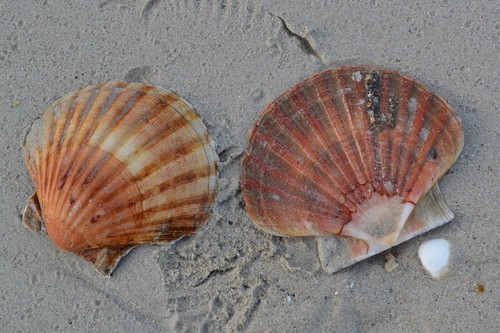
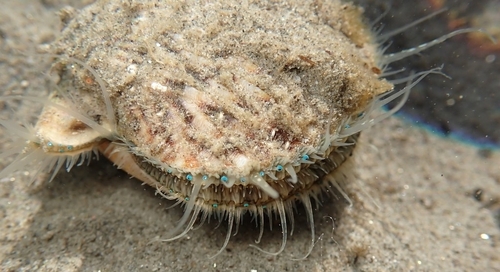
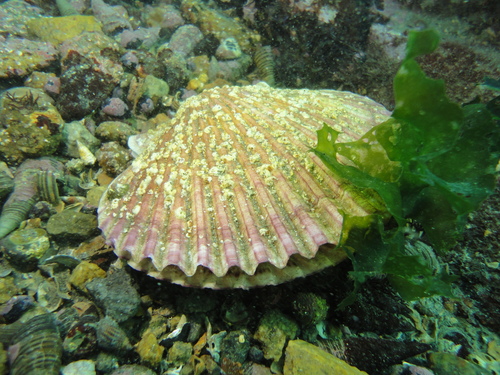
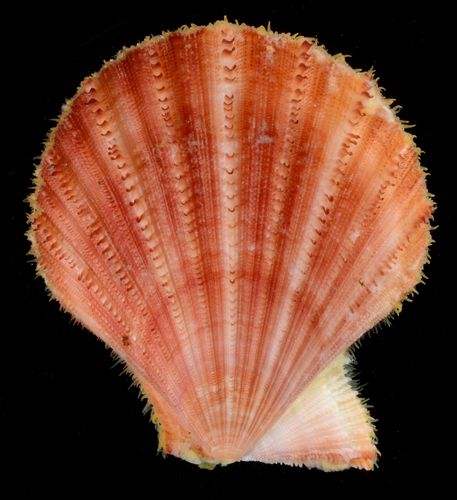
Chlamys hastata, commonly called the spiny scallop, has a slightly fan-shaped shell that can reach about 9 centimetres (3.5 in) in height, though a more typical adult size is 6 centimetres (2.4 in). The shell has two convex valves, each with a small number of broad ribs that radiate from the umbone, the rounded protuberance near the hinge. These ribs are covered in blunt spines, and fine etched striations lie between the ribs. The shell's base color is white, with radial pale purple bands; the right valve, which usually sits underneath, is paler than the left valve. Annual growth rings are visible as concentric bands of a different color. Two irregular shell flaps called auricles sit beside the hinge, with the anterior auricle normally much larger than the posterior one. This structure provides an attachment point for the single strong adductor muscle that closes the shell. On either side of the long hinge are small ridges and grooves called teeth, which stop the valves from sliding sideways relative to each other. Unlike many bivalves, the spiny scallop does not have large 'cardinal' teeth on the hinge directly below the umbone. Instead, it has 5 or 6 lateral teeth on each side of the hinge. Lining the inside of the valves is the mantle, a membrane that covers the gut and other internal organs. It appears as a thick, sandwich filling-like layer along the margins of the valves, fringed with many short tentacles, and has a row of tiny simple eyes close to each valve. The spiny scallop normally rests on its right valve, and a colonial sponge often grows on its exposed left valve. This species can be distinguished from its close relative the Pacific pink scallop (Chlamys rubida) by its less rounded valves, and by the small curved spines on its ribs that give it a rough texture, while the Pacific pink scallop's shell feels smooth. The glossy white interior of the spiny scallop's shell also usually has a purplish blotch near the umbone that is not present in the Pacific pink scallop.
The spiny scallop is native to the west coast of North America, with a range extending from the Gulf of Alaska to San Diego in southern California. It lives on the seabed on substrates of sand, gravel, or crushed shell, among boulders, down to depths of around 150 metres (490 ft). It is also found in seagrass meadows and on rocky shores, and prefers locations with strong currents.
Known predators of the spiny scallop include starfish (specifically the ochre star Pisaster ochraceus and the sunflower star Pycnopodia helianthoides), octopuses, and sea otters. To escape predators, the spiny scallop can swim by repeatedly opening and closing its valves in a clapping motion. Each time the valves close, water is expelled through a gap in the mantle on the dorsal side of the hinge, propelling the animal forward margin first in a form of jet propulsion. Chemoreceptors on the mantle margins detect approaching starfish, triggering this evasive action. It also responds this way to sponge-eating predators, such as nudibranchs of the genus Archidoris.
The spiny scallop usually has a symbiotic relationship with an encrusting sponge that grows on its left valve. The sponge is most often the orange Myxilla incrustans, but is sometimes the purple or brown Mycale adhaerens. The sponge provides camouflage for the scallop, and may deter predator attacks because many sponges produce a repulsive odor and are distasteful. It also makes it harder for a starfish to get a secure grip with its tube feet, which starfish need to pry the scallop's valves apart. The sponge benefits from living on the scallop because this prevents it from being buried in sediment. In the wild, both spiny scallops and their encrusting sponges grow to a larger size in areas of high water turbidity. One laboratory study found that when sediment was stirred frequently, all sponges on empty scallop shells died, while sponges on living scallop shells thrived. However, another study found that growth rates were significantly lower in spiny scallops heavily encrusted by sponges compared to unencumbered individuals.
Other organisms also grow on the spiny scallop's shell. The boring sponge Cliona celata is a parasitic species that creates holes up to 1.5 millimetres (0.059 in) in diameter in the valve. Other common surface-dwelling epibionts include tube worms, barnacles, and bryozoans. In a survey off the San Juan Islands, Washington, 144 scallops (a mix of C. hastata and C. rubida) were dredged, mostly from a depth of 90 metres (300 ft). The right valve was much more heavily colonized by epibionts than the left: 76% of right valves were covered, compared to just 17% of left valves. Encrusting sponges (mostly Mycale adhaerens) were common, alongside the barnacle Balanus rostratus, and tube worms Neosabellaria cementarium, Serpula vermicularis, and Spirorbis sp. Other bivalves, bryozoans, brachiopods, and tunicates were also found. Many worm tubes were unoccupied, and other organisms overgrew both living and dead calcareous tubes. Cyclostome and cheilostome bryozoans were the most common epibionts on the lower left valve. Starfish are equally able to force open the valves of scallops with barnacles and those without. Barnacles are normally sessile animals that cannot evade predators, so they benefit from being attached to a scallop that can perform defensive evasion. However, the presence of barnacles disadvantages the scallop by reducing its ability to swim. Encrusting sponges emit chemicals that discourage barnacle larvae from settling nearby, so larvae preferentially settle on shells not encrusted with sponges. This is another advantage for the scallop, as sponges impede swimming ability far less than barnacles do.