About Chlamydotis undulata (Jacquin, 1784)
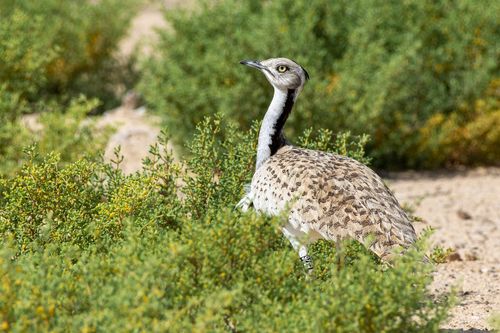
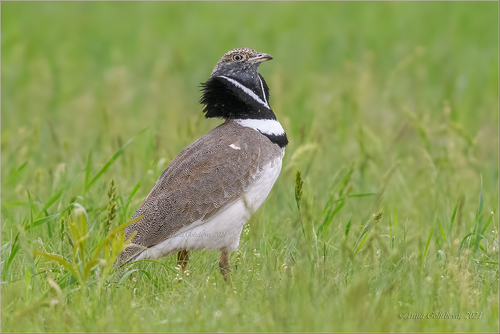
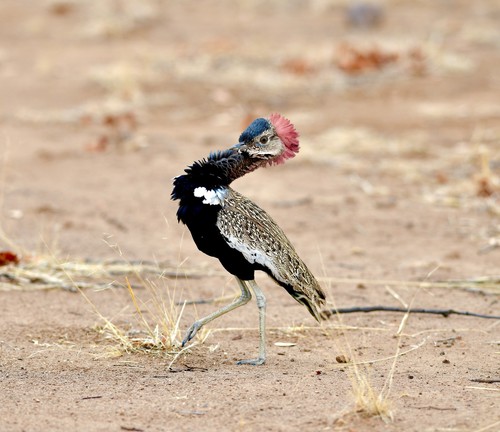
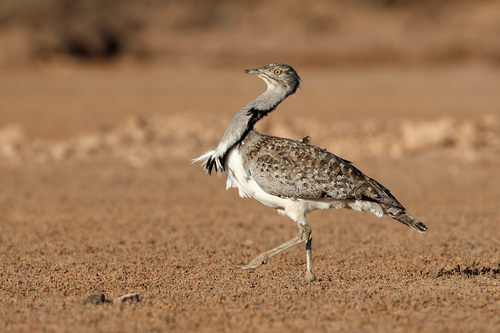
The African houbara (Chlamydotis undulata), scientifically described by Jacquin in 1784, is a small to mid-sized bustard. It has a body length of 55–75 cm (22–30 in) and a wingspan of 135–170 cm (53–67 in). Its upper plumage is brown, while its underparts are white, and it has a black stripe running down the sides of its neck. In flight, its long flight feathers display large patches of black and brown. The sexes are similar in appearance, but females are smaller and greyer on the upper body than males: females measure 55–65 cm (22–26 in) in height, while males measure 65–75 cm (26–30 in). Body mass ranges from 1.8–3.2 kg (4.0–7.1 lb) for males and 1.2–1.7 kg (2.6–3.7 lb) for females. This species is found in North Africa west of the Nile, mainly in the western Sahara desert region, where it occurs in Algeria, Egypt, Libya, Mauritania, Morocco, Tunisia and Western Sahara. There are also old historical records of the species from Sudan, and a small population resides in the Canary Islands. The Asian houbara, also called MacQueen's bustard, was formerly included within this species and occurs east of the Sinai Peninsula. Unlike the migratory northern populations of MacQueen's bustards, the North African African houbara is sedentary. The Canary Islands subspecies C. u. fuertaventurae has a highly restricted range and is classified as endangered; a 1997 survey recorded its total population as approximately 500 birds. African houbaras have a flamboyant breeding display where they raise the white feathers of the head and neck while withdrawing the head. Females lay two to four eggs directly on the ground. The species rarely vocalizes, but males produce 3–5 low booming notes during their breeding displays. It is omnivorous, feeding on seeds, insects, and other small creatures.