About Chlamydotis macqueenii (J.E.Gray, 1832)
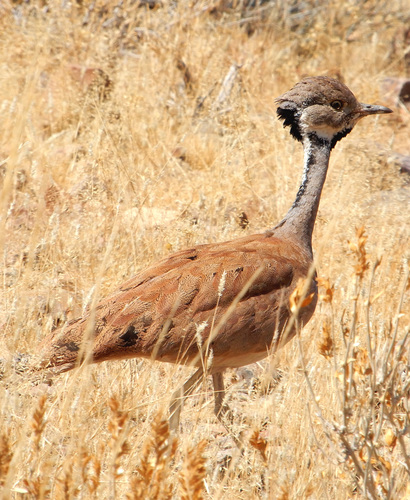
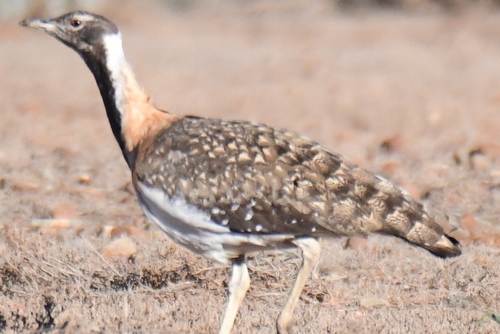
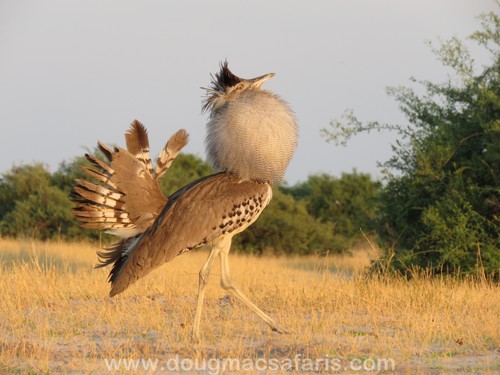
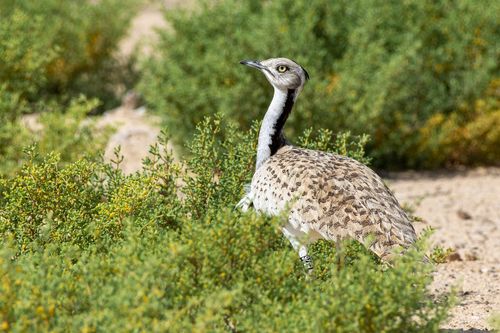
This medium-sized bustard, Chlamydotis macqueenii, is about 65 cm (26 in) long with a 140 cm (55 in) wingspan. It is brown on its upperparts and white on its underparts, with black stripes running down the sides of its neck. In flight, its long wings show large areas of black and brown on the flight feathers, plus a white patch at the base of the primaries. Viewed from below, the wing is mostly white with a black trailing edge. Sexes are similar in plumage, but the female is smaller and paler on the upperparts. A morphometric study of around 79 sexed Asian houbara from Pakistan found that males were 9 to 15% larger than females for most measurements, and discriminant analysis correctly identified sex based on these measurements in about 99% of cases. The Asian houbara ranges from east of the Sinai Peninsula to the Caspian Sea, extending east to the Gobi Desert in Mongolia. Northern populations migrate further south to winter mainly in western Balochistan, Pakistan, and the dry arid zone of western India. Vagrants have historically been found as far west and north as Britain, and as far south as Kanhangad in northern Kerala. Vagrant individuals were shot in Lincolnshire in October 1847, and in Yorkshire and Aberdeenshire both in October 1898; the most recent confirmed vagrant in Britain was recorded in Suffolk from November to December 1962. This species breeds in deserts and other very arid sandy areas. A study in Saudi Arabia found the species is heavily dependent on good vegetation cover, and tends to occur in areas with dense scrub growth, particularly Capparis spinosa. A study in Iranian steppes found that nest sites are mainly chosen for their high density of insect prey, which correlates with local vegetation characteristics. During courtship display, the male initially holds his neck upright, erects feathers at the base of the neck and a few feathers on the head, and walks slowly, placing one foot carefully just ahead of the other. This is followed by a more active phase where the male runs either in a straight line or in a circle around a small number of bushes, tucks his neck back into an S shape, keeps neck feathers erected to cover his head, lifts his feet in a measured gait, and sways his neck from side to side. A low breathing sound can be heard during this display, but only at close range. Males call during display, and will repeat the display if no potential mate is present. When a female appears receptive, the male puffs up the black feathers on the sides of his neck to form a black collar or ruff, then walks toward the female while twisting his body from side to side. Males are polygynous, mating with multiple females; after mating, the female alone builds the nest and incubates the clutch. The clutch contains 2 to 4 eggs, laid in a bare scrape dug into the ground. Eggs hatch after approximately 23 days. Like all bustards, Asian houbara chicks are nidifugous: they leave the nest immediately after hatching and follow their mother, who collects insects and passes them to the chicks with her beak. Young birds fledge after about 30 days, but remain close to their mother for several months. When pursued by falcons (such as saker falcons or peregrine falcons) during falconry, the bustard climbs into the air and spirals to avoid being struck. It has been reported that the species may also defend itself by defecating on the falcon; the sticky green faeces are said to cause the falcon's wings to stick and make it crash to the ground. This species is omnivorous, feeding on seeds, berries, insects, and other invertebrates. It does not drink free water, instead obtaining all required moisture from its diet. One study found tenebrionid beetles to be especially common in its diet. Plant material makes up a larger proportion of the diet during the non-breeding season.