About Chlamydosaurus kingii Gray, 1825
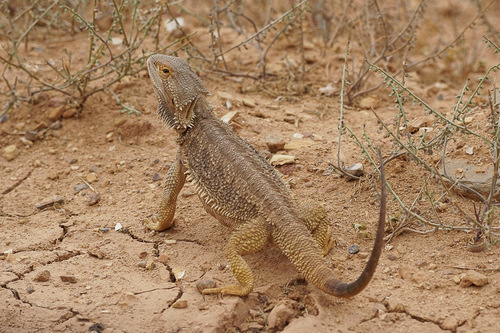
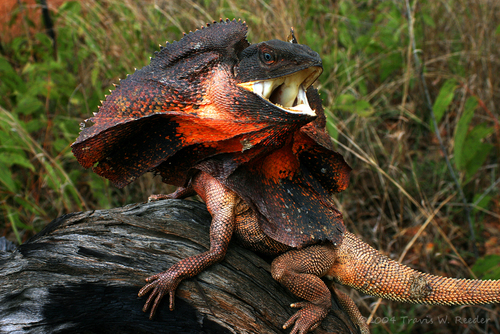
Chlamydosaurus kingii, commonly called the frilled lizard, reaches a total length of roughly 90 centimetres (35 in), a head-body length of 27 cm (11 in), and weighs at least 600 g (1.3 lb). It has a notably large, wide head, a long neck that accommodates its signature frill, long legs, and a tail that makes up most of its total body length. This species shows sexual dimorphism: males are larger than females, and have proportionally larger frills, heads, and jaws. The corners of the frilled lizard's eyes are pointed, and its rounded nostrils face away from one another and angle downward. Most of the lizard's scales are keeled, meaning they have a ridge running down their center. Scales alternate between small and large from the lizard's backbone out to its sides. The species' distinctive frill is a flap of skin that extends from the head and neck and contains multiple folded ridges. When fully extended, the frill forms a disc shape that can measure over four times the length of the animal's torso in diameter, or around 30 cm (12 in) across. When not extended, the frill wraps around the lizard's body, lying like a cape over the neck and shoulders. The frill is laterally symmetrical; its right and left sides attach at the bottom in a V-shape, and cartilage-like connective tissue called Grey's cartilage connects the top ends to each side of the head near the ear openings. The frill is supported by rod-like hyoid bones, and is extended through movements of these bones, the lower jaw, and Grey's cartilage. The main functions of the frill are as a threat display to predators and for communication between individual lizards. It can also provide camouflage when folded, but this is unlikely to be a result of natural selection pressure. There is a hypothesis that the frill may act like a directional microphone to help the lizard better hear sounds coming directly in front of it, but there is no evidence to support other commonly suggested functions including food storage, gliding, or temperature regulation. Frilled lizards have dorsal coloration that ranges between grey, brown, orangish-brown, and black, with a paler white or yellow underside. Males have a dark belly but a lighter coloured chest. Dark brown markings are scattered across the species' underside and lateral sides, and these markings merge to form bands on the tail. Frill colour varies by the lizard's geographic range: lizards west of the Ord River have red frills, lizards between the Ord River and the Carpentarian Gap have orange frills, and lizards east of the Carpentarian Gap have yellow to white frills. All New Guinean frilled lizards have yellow frills. More colourful frills often have white patches that may enhance their display function. Frilled lizard colouration is produced mainly by carotenoid and pteridine pigments. Red and orange frilled lizards have higher amounts of carotenoids than yellow and white frilled lizards, and yellow and white frilled lizards do not have pteridines. Yellow frill colouration has been linked to higher steroid hormone levels. The frilled lizard lives in northern Australia and southern New Guinea. In Australia, its range stretches east from the Kimberley region of Western Australia through the Top End of the Northern Territory to Queensland's Cape York Peninsula and the nearby islands of Muralug, Badu, and Moa, extending south to Brisbane. In New Guinea, it occupies the Trans-Fly ecosystem on both the Papua New Guinean and Indonesian portions of the island. This species mainly lives in savannahs and sclerophyll woodlands. It prefers elevated areas with good soil drainage and a higher diversity of tree species, most commonly Eucalyptus species, and avoids low plains dominated by Melaleuca and Pandanus trees. Frilled lizards also favour areas with less ground-level vegetation, which lets them spot prey more easily from above. The frilled lizard is a diurnal (active during the daytime) arboreal species, spending over 90% of each day in trees. It spends as little time on the ground as possible, only descending mainly to feed, interact socially, or move to a new tree. At Kakadu National Park, males move an average of 69 m (75 yd) per day, compared to 23 m (25 yd) for females. In the same park, males have an average home range of 1.96 ha (4.8 acres) during the dry season and 2.53 ha (6.3 acres) during the wet season, while females have a home range of 0.63 ha (1.6 acres) in the wet season and 0.68 ha (1.7 acres) in the dry season. Males defend their territory boundaries using frill displays. Frilled lizards are capable of moving bipedally, and do so when hunting or escaping predators. To stay balanced while moving on two legs, they lean their heads far back enough that it aligns behind the base of their tail. These lizards are more active during the wet season, when they choose smaller trees and are seen more often near ground level; during the dry season, they use larger trees and are found at greater heights. Frilled lizards do not become torpid during the dry season, but they can greatly reduce their energy use and metabolic rate when food and water are scarce. Their body temperatures can reach close to 40 °C (104 °F). The species basks vertically on main tree trunks in the morning and near the end of the day, though in the dry season they stop basking once they reach a lower body temperature to better conserve energy and water. When temperatures rise during the day, they climb higher into the canopy to find shade. During wildfires, frilled lizards take refuge in large trees and termite mounds. After a forest burns, they select trees with more continuous canopies. Frilled lizards feed primarily on insects and other invertebrates, and very rarely eat vertebrates. Important prey items include termites, ants, and centipedes; termites are a particularly critical food source during the dry season, while moth larvae become important during the wet season. Ant consumption drops after early dry season fires, but increases after fires that occur later in the season. This species is a sit-and-wait predator: it watches for potential prey from a tree, and when it spots prey it climbs down, rushes toward the prey on two legs, then lowers to all four legs to grab and eat it. After feeding, it returns back up into a tree. Predators of frilled lizards include birds of prey, larger lizards, and larger snakes. When threatened, the lizard extends its frill to make itself appear larger. This threat display is paired with a gaping mouth, puffing of the body, hissing, and lashing with the tail. The lizard may also flee and hide from predators. Several species of nematode infect the gastrointestinal tract of frilled lizards, and there is at least one recorded case of an individual dying from cryptosporidiosis. Frilled lizards breed during the late dry and early wet seasons. Competing males display toward one another with gaping mouths and spread frills, and fights can break out where the lizards pounce and bite each other's heads. Females dig a shallow cavity to deposit their eggs. A female can lay multiple clutches per breeding season, and clutch size can range from four to more than 20 eggs. Incubation takes two to four months; milder incubation temperatures produce more male hatchlings, while more extreme temperatures produce more female hatchlings. Hatchlings have proportionally smaller frills than adult frilled lizards. Lizards grow during the wet season when food is more abundant, and males grow faster than females. Juvenile males also disperse farther from their hatching site than females. This species reaches sexual maturity within two years; males live up to six years, while females live up to four years.