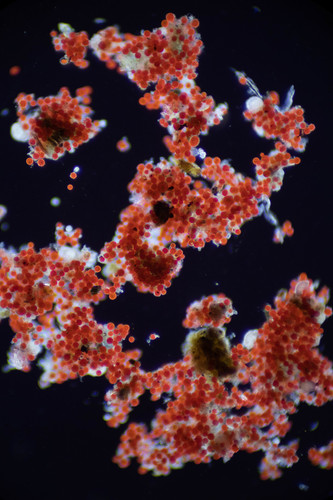
About Chlamydomonas nivalis (F.A.Bauer) Wille
The seasonal life cycle of Chlamydomonas nivalis is divided into three stages, each defined by cell color that corresponds to differing carotenoid composition: green, orange, and red. Red and green cells are the easiest to tell apart due to their large compositional differences, while orange and red cells are the most difficult to distinguish because they look very similar. In the past, red-stage cells were classified as a separate species from green-stage cells, but it was later determined that they are simply different stages of C. nivalis' complex life cycle. Small, green, motile cells of young C. nivalis in the green stage form in spring or early summer, when warmer temperatures trigger zygotes to undergo meiosis in meltwater pools. These biflagellated cells are slightly oval and measure approximately 5-15 μm in diameter. During this asexual reproductive phase, cells are sensitive to temperature and drought stress. They avoid unfavorable light and temperature conditions by swimming through snow until they reach a more optimal environment. Green-stage cells have irregularly shaped chloroplasts. Chlorophyll, the dominant pigment, gives the cells their characteristic green color and enables maximum growth via light absorption. Secondary carotenoid concentrations are much lower at this stage, because cells require photosynthetically active radiation for energy and growth. Green-stage cells also carry fewer organic and inorganic particles on their surface compared to mature cysts. Later in the growing season, when nitrogen and other nutrients become limited and radiation stress increases, green cells develop into flagellated sexual gametes. These gametes mate to produce new zygotes that lose their flagella and are able to survive through winter. The transformation into a zygote (also called a hypnoblast) is marked by the production and accumulation of reserve materials including sugars and lipids, as well as the formation of esterified secondary carotenoids. As these secondary carotenoids accumulate around the cell's plastids to protect zygotes from UV radiation, they turn green zygotes orange. Both orange and red spores can be found throughout the summer. During this stage, the cell wall also begins to thicken to help the cell tolerate freezing temperatures and UV light. Additionally, the color of these pigments lowers albedo, allowing individual cells to melt nearby ice and snow crystals to access nutrients and water that would otherwise be unavailable in frozen conditions. C. nivalis has been documented worldwide across every continent, in mountainous regions, polar regions, and snowfields. It is the most abundant snow alga, and typically makes up the majority of cells identified in samples collected from various sites. Most of the habitats occupied by this alga are very different from those of other species in the genus Chlamydomonas. Known habitats include, but are not limited to, snow, rock surfaces, soil, meltwater, and cryoconite holes. The environmental conditions C. nivalis typically experiences are considered extreme: cells face low nutrient availability, acidity, intense sunlight, high radiation, extreme temperature shifts, and periods of complete darkness. Experimental work has shown that red-snow C. nivalis growth is limited by both nutrients (nitrogen, phosphorus, and potassium) and liquid water. C. nivalis spends most of its life in the cyst stage, embedded in snow at depths ranging from 0 to 20 centimeters (0.0 to 7.9 in). Its depth can shift depending on whether the cell is in a mobile, motile stage, if snow melts with the arrival of warm weather, or if new precipitation adds more snow above the cells. Cells exposed on unshaded snow can be subjected to high levels of visible light and ultraviolet radiation for long periods, while cells deep below the snow surface may experience total darkness. In its flagellated, motile stage, the cell can move through snow until it reaches an optimal position with suitable moisture, light, and temperature. When in the non-motile cyst stage, C. nivalis cells rely on the flow of meltwater to carry them to a favorable location by chance. This species can survive temperatures ranging from below 0 °C to just above 20 °C. Growth is slow when temperatures are below 5 °C. Between 5 and 15 °C, C. nivalis cells grow faster than Chlamydomonas reinhardtii cells. The two species grow at the same rate between 20 and 25 °C. C. nivalis growth is suppressed when temperatures rise above 30 °C. It is considered a true snow alga because it performs better at low temperatures than at warm temperatures. Due to its ability to photosynthesize effectively from cold to moderate temperatures, this species is classified as a cryotolerant mesophile rather than a cryophile. This organism is also highly resilient: it can survive in warm soil for weeks, and can tolerate dryness and room temperature for up to 6 months. Fungi, worms, bacteria, and viruses are known to associate with C. nivalis or share its environment. Encapsulated rod-shaped gram-negative bacteria have been found on the surface of C. nivalis cysts. These unknown bacteria were not detected in control samples that lacked C. nivalis, which strongly suggests a specific association with the alga. Another bacterium, Mesorhizobium loti, was originally found as a contaminant in C. nivalis cultures, but further testing suggests this bacterium may synthesize vitamin B12 for the alga. In cryoconite holes, C. nivalis occurs alongside bacteria, virus-like particles, ciliates, and other chlorophyte species. Ice worms have been found to preferentially live under C. nivalis on glaciers, possibly using the alga as a food source. Infections of C. nivalis cells by chytrids (specifically Chytridium chlamydococci), filamentous fungi, and Selenotila nivalis have also been observed. As winter approaches, cells enter the final stage of their life cycle. Orange cells mature into red cysts, the form they retain for the remainder of their life cycle, which is also the longest stage. Cells at this stage are the most resistant to harsh environmental conditions. Inorganic and organic materials including bacteria, fungi, and dust particles coat the mucilage layer of the cell wall. The inorganic impurities found here are rich in silicon, iron, and aluminum. These elements can also be taken up into the cell and stored in vacuoles, and may act as an important mineral supply for the alga. As the boundary that protects the cell's internal contents from harsh habitat conditions, the cell wall is very rigid and difficult to destroy. It may also help protect algal cells from desiccation during alternating freeze-thaw cycles that occur with seasonal changes. The non-motile spherical red cysts range from 35 to 40 μm in diameter. Each cell contains a single central chloroplast that holds a naked pyrenoid, ribosomes, starch grains, and numerous small grana stacks made of 3 to 7 thylakoids. Negatively charged phosphatidylglycerol makes up the majority of the thylakoid membranes. The thylakoid membrane lipid composition can also shift to increase lipid fluidity in response to lower temperatures. An undulated membrane surrounds the chloroplast. Lipid bodies and carotenoid globules surround the plastid. A red secondary pigment, astaxanthin, and its esterified derivatives, accumulate to up to 20 times the amount of chlorophyll a in the cytoplasmic lipid bodies of mature red spores. Astaxanthin protects the chloroplast from excessive light by absorbing a portion of incoming radiation before it reaches the photosynthetic apparatus, which prevents photoinhibition and UV damage. The absorbed radiation is converted to heat, which helps melt nearby snow and ice crystals to access needed nutrients and liquid water. Astaxanthin can also act as a metabolic sink for non-dividing, metabolically active spores. The cytoplasm holds several small cytoplasmic vacuoles that contain partially crystallized content. While mitochondria are present, they are not easily visible. Most cytoplasmic space is occupied by the large plastid, lipid bodies, and carotenoid globules. C. nivalis has a single centrally located nucleus, which is positioned such that it is covered by astaxanthin-filled carotenoid globules that provide UV protection. 91% of astaxanthin derivatives are stored in their monoester form within dormant C. nivalis red cysts. Astaxanthin is the pigment that gives the cell its deep red color. Other pigments that can be found in C. nivalis include violaxanthin and adonirubin.

