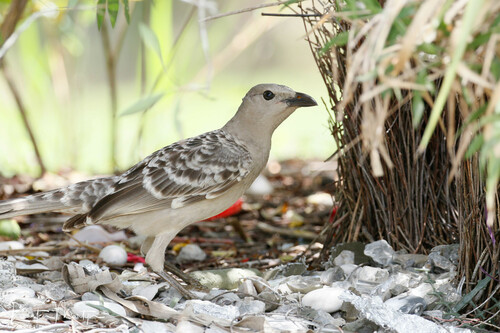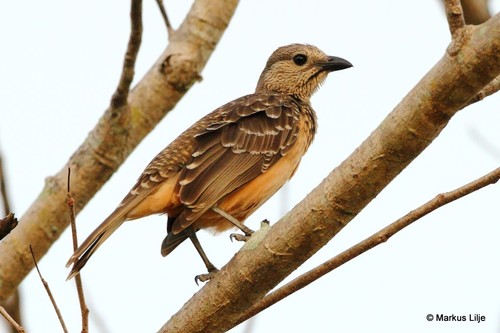
About Chlamydera maculata (Gould, 1837)
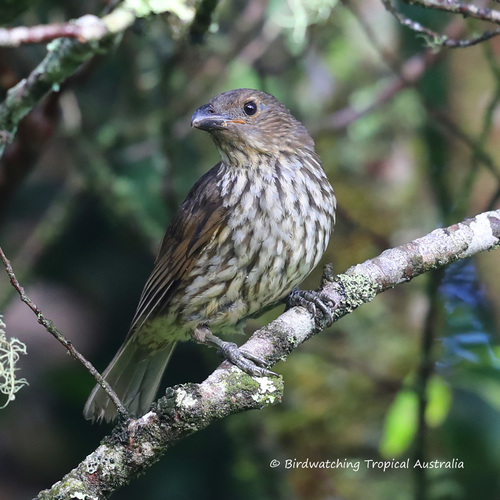
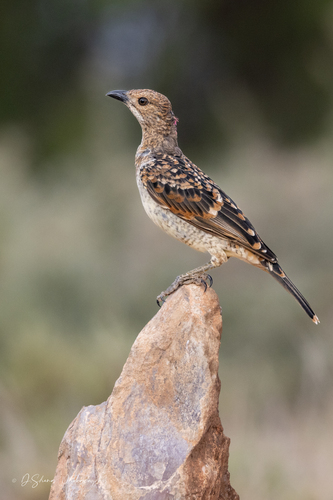
The spotted bowerbird, Chlamydera maculata, measures 29 cm in length. It is intermediate in size among bowerbirds, with a rather slim, compact build. This species is sexually monomorphic: it has a pale rufous head streaked with grey-brown, and a lilac-pink crest on its nape. Upperparts are blackish-brown, extensively marked with amber spots. Paler underparts are cream with greyish scalloping and barring, and the lower belly and undertail have a slight yellow tint. The bill is black, eyes are dark brown, and legs are olive-brown.
Spotted bowerbirds produce a diverse range of vocalisations. Typical calls include loud, harsh churrings and other notes, along with the complex vocal mimicry that is characteristic of this group of bowerbirds. They are skilled vocal mimics that can replicate the calls of many birds and other types of sounds. When approached by humans or other potential threats, males at bowers and females at nests often mimic the calls of predatory birds, including the wedge-tailed eagle (Aquila audax), blue-winged kookaburra (Dacelo leachii), grey-crowned babbler (Pomatostomus temporalis), grey butcherbird (Cracticus torquatus), pied butcherbird (Cracticus nigrogularis), Australian magpie (Gymnorhina tibicen), Australian raven (Corvus coronoides), apostlebird (Struthidea cinerea) and honeyeaters (Meliphagidae spp.), among other species. Other sounds they mimic include large herbivores moving through scrub or over fallen branches, the twang of fence wire, wood chopping, the crack of a stock whip, and the whistling flight of crested pigeons.
Spotted bowerbirds are most commonly found in dry, open sclerophyll woodlands with dense understories of small trees and shrubs, where their plumage provides good camouflage. They show a particular preference for habitats dominated by eucalypt species (Eucalyptus) and/or brigalow (Acacia harpophylla), and have a strong association with riverine woodlands. They often live in orchards and parks, and frequently visit rural homesteads and gardens.
The diet of spotted bowerbirds consists mostly of fruit, flowers, and seeds, but they also consume arthropods. They are known to take food scraps from campsites and houses, and raid orchards and gardens for fruit. They usually forage alone or in small groups, but may sometimes gather in flocks of 10 to 30 birds when they are not attending to nests or bowers.