About Chlamydera cerviniventris Gould, 1850
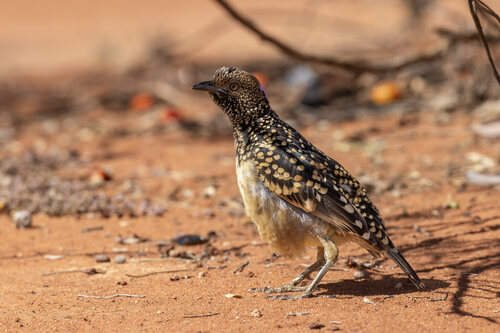
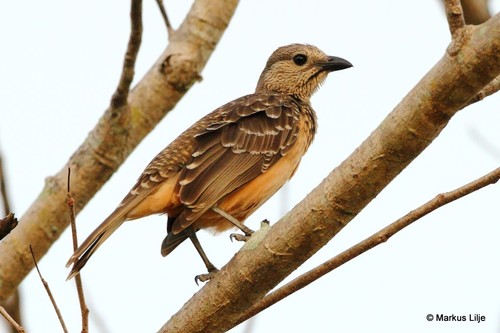
The fawn-breasted bowerbird (Chlamydera cerviniventris, formally described by Gould in 1850) is a medium-sized bowerbird, reaching up to 32 cm (13 inches) in length. It has greyish brown plumage spotted with white, a black bill, dark brown iris, yellow mouth, and orange-buff underparts. The sexes have similar appearance, with the female only slightly smaller than the male. This species is distributed across New Guinea and northern Cape York Peninsula in Queensland, Australia. It lives in tropical forests, mangroves, savanna woodlands, and forest edges. Its diet is primarily made up of figs, other fruits, and insects. The species builds a loose cup-shaped nest from small sticks, placed high in a tree. The mating bower it constructs is an avenue-type structure with two side walls made of sticks, and it is usually decorated with green berries. The fawn-breasted bowerbird is common across its range, and is currently evaluated as Least Concern on the IUCN Red List of Threatened Species. Below is an account written by expedition naturalist John MacGillivray, published in the Narrative of the Voyage of H.M.S. Rattlesnake 1846-1850, Volume I, pages 323–325, that documents the first recorded observation and specimen collection of this species: Two days before we left Cape York I was told that some bower-birds had been seen in a thicket, or patch of low scrub, half a mile from the beach, and after a long search I found a recently constructed bower, four feet long and eighteen inches high, with some fresh berries lying upon it. The bower was situated near the border of the thicket, the bushes composing which were seldom more than ten feet high, growing in smooth sandy soil without grass. Next morning I was landed before daylight, and proceeded to the place in company with Paida, taking with us a large board on which to carry off the bower specimen. I had great difficulty in inducing my friend to accompany me, as he was afraid of a war party of Gomokudins, which tribe had lately given notice that they were coming to fight the Evans Bay people. However I promised to protect him, and loaded one barrel with ball, which gave him increased confidence, still he insisted on carrying a large bundle of spears and a throwing-stick. Of late Paida's tribe have taken steps to prevent being surprised by their enemies. At night they remove in their canoes to the neighbouring island Robumo, and sleep there, returning in the morning to the shore, and take care not to go away to a distance singly or unarmed. While watching in the scrub I caught several glimpses of the tervinya (the native name) as it darted through the bushes in the neighbourhood of the bower, announcing its presence by an occasional loud churr-r-r, and imitating the notes of various other birds, especially the leather-head. I never before met with a more wary bird, and for a long time it enticed me to follow it to a short distance, then flying off and alighting on the bower, it would deposit a berry or two, run through, and be off again (as the black told me) before I could reach the spot. At length, just as my patience was being exhausted, I saw the bird enter the bower and disappear, when I fired at random through the twigs, fortunately with effect. So closely had we concealed ourselves latterly, and so silent had we been, that a kangaroo while feeding actually hopped up within fifteen yards, unconscious of our presence until fired at. My bower-bird proved to be a new species, since described by Mr. Gould as Chlamydera cerviniventris, and the bower is exhibited in the British Museum.