About Chitonotus pugetensis (Steindachner, 1876)
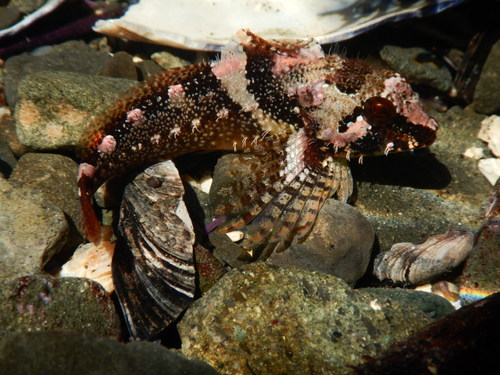
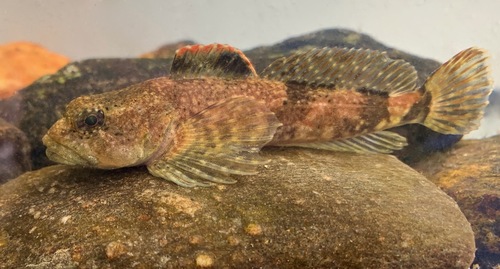
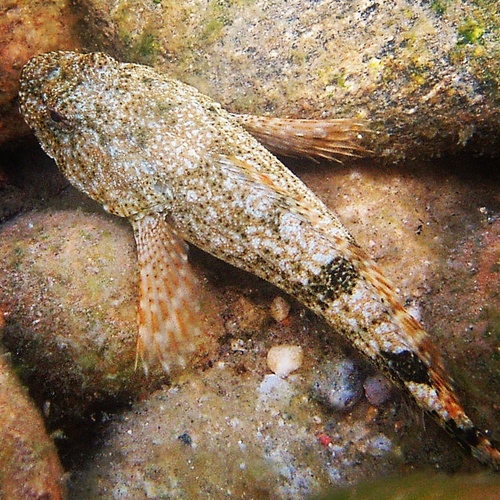
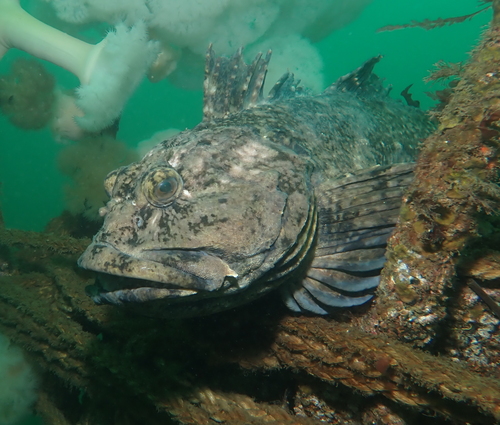
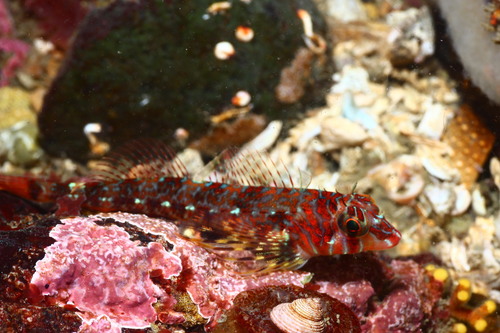
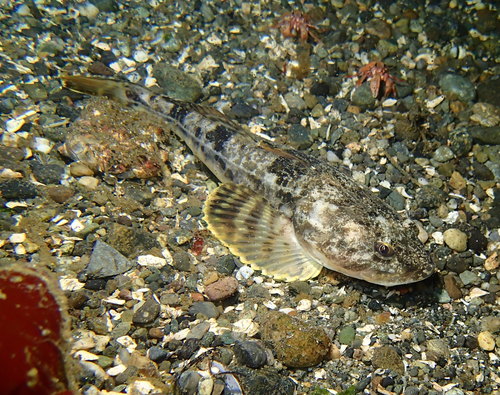
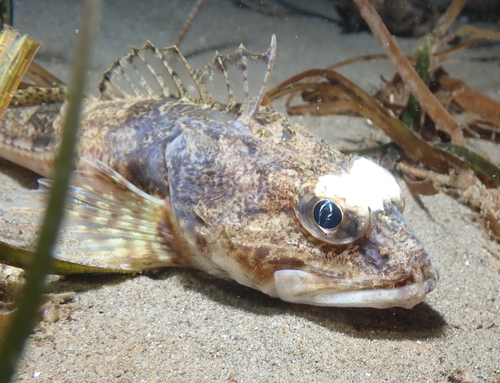
Chitonotus pugetensis, commonly called the roughback sculpin, has an elongated body that tapers toward the tail, and is almost entirely covered in large scales. Its large head is wide and flattened. The upper body is colored brown and gray, fading to white on the belly. Dark saddle-shaped markings and blotches run along the back and upper flanks. The first dorsal fin has a black margin, and a red blotch develops on it during the breeding season. Large branched spines that resemble antlers grow on the fish's cheeks. The first spine in the dorsal fin is elongated, and there is a deep incision between the third and fourth dorsal spines. The dorsal fins are supported by 10 or 11 spines and 14 to 17 soft rays. The anal fin contains 14 to 17 soft rays, the pectoral fins have 16 to 18 rays, and the pelvic fins have one spine and 3 soft rays. The large caudal fin is rounded. The maximum published total length for this species is 23 cm (9.1 in).
The roughback sculpin is found in the eastern Pacific Ocean, along the western coast of North America. Its range extends from Bahia Santa Maria in Baja California Sur, Mexico, north to Trail Island in the Wark Channel of British Columbia, and it probably also occurs in southeastern Alaska. It is a demersal fish that lives on sand, gravel, small rock, and rock substrates, from the intertidal zone down to depths of 144 m (472 ft).