About Chiton glaucus Gray, 1828
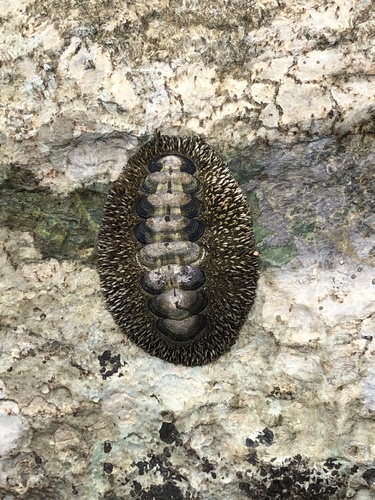
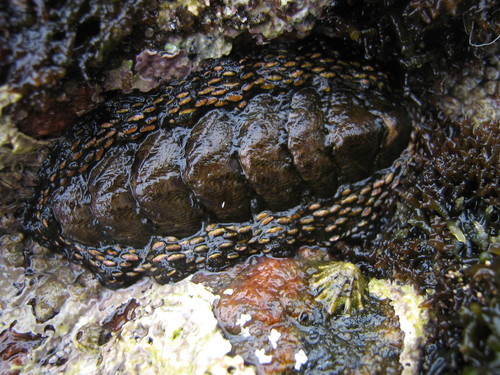
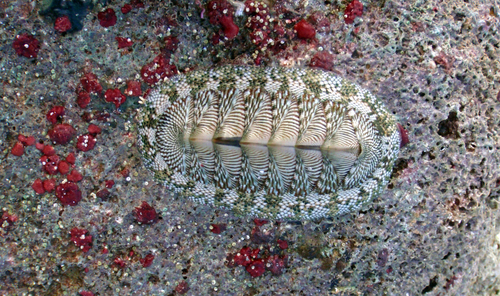
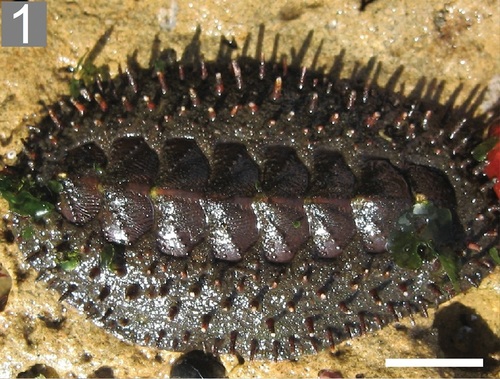
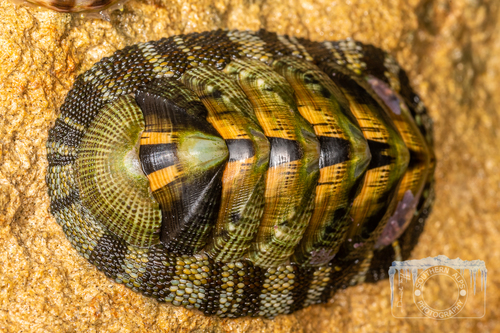
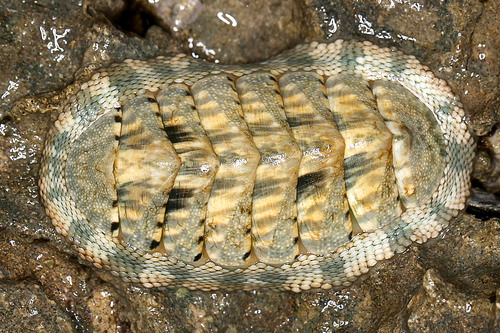
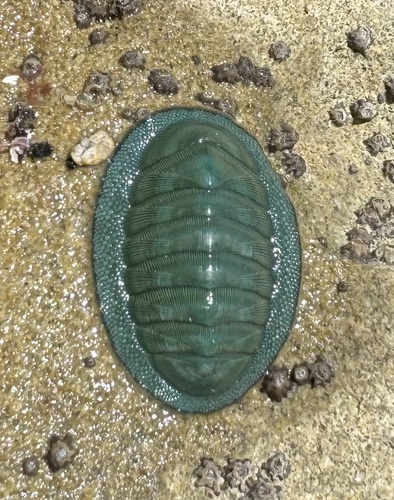
Chiton glaucus has an oval shape, with a slightly elevated but distinct ridge running down its back, giving it bilateral symmetry. Adults most commonly measure 30–35 mm in length, though the species can reach up to 55 mm long. Like other chitons, taxonomists distinguish Chiton glaucus from related species using characteristics of its shell valves and surrounding girdle. Its shell is made up of eight overlapping valves: two terminal valves at each end, with six intermediate valves between them. The valves are surrounded by a girdle, which aids adhesion to surfaces; in Chiton glaucus, this girdle is covered in large scales. The valves and girdle are most often a uniform green, but brown, buff, and even light blue individuals have been recorded, especially in northern New Zealand. Some individuals also have lighter chevron or zigzag markings. On the underside of the body, a large foot extends the full length of the chiton, which it uses to suction onto substrates. Gills are not prominent, and are arranged in sets along either side of the foot. A small, simple cavity mouth sits at one end of the foot.
Within New Zealand, Chiton glaucus is found on the North Island, South Island, Stewart Island, and the Chatham Islands. It is also present in Tasmania, where it is very common in estuaries. It is thought to have been introduced to Tasmania via shipping activity between Australia and New Zealand. Chiton glaucus inhabits rocky substrates, and rocky tide pools form a major part of its habitat. It occurs in intertidal or subtidal zones across a broad range of environments, including exposed open shores and sheltered estuarine sites. In estuarine sites, Chiton glaucus hides under stones and bivalve shells, especially cockle shells, to avoid visual predators during daylight. In more exposed areas, it is found directly on stones and cobbles. This chiton can survive in muddy environments, particularly estuaries, and can also live in semi-polluted areas.
Overall, little is known about the general habits of chitons, but observations have improved understanding of spawning and related processes. Research on a common local chiton on the Great Barrier Reef in Queensland found that this species consistently spawned on the night of the full moon. Spawning only occurred when conditions were favourable; if conditions such as tide roughness were unsuitable, spawning would be delayed until the next full moon, even if favourable conditions occurred between full moons. Generally, chiton spawning is synchronous, but it is not always correlated with any particular stage of the lunar or solar cycle. Chitons have separate sexes, and they release sperm and eggs through a simple gonad located near the posterior end of the foot. Chitons do not have a free-swimming larval stage, so the species does not have particularly broad natural distribution. After an egg is released through the anus, it moves into plankton via water currents and hatches after approximately two days. Metamorphosis then occurs to trigger larval settlement. The changes during metamorphosis are not dramatic, but it initiates the biomineralisation of the adult valves and radula. After metamorphosis, the prototroch and apical tuft are shed, the organism's shape changes from elongated to oval, and the juvenile is left with only seven calcareous valves. One month later, the eighth valve becomes visible, and two red larval spots develop; these spots are lost when the chiton reaches maturity.