About Chitala ornata (Gray, 1831)
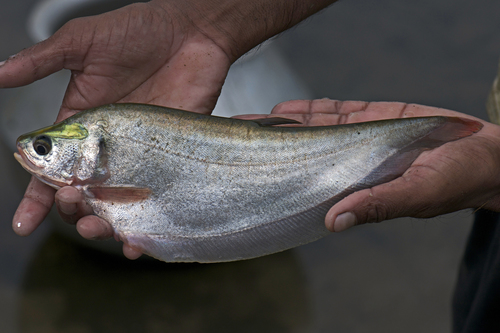
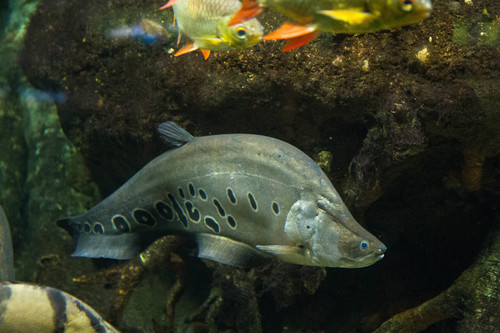
All species in the genus Chitala have unique physical traits that distinguish them from other fish. C. ornata has a grey-silver, laterally compressed body and a long anal fin that extends to the caudal fin, giving the fish an overall knife-like shape. A row of 6 to 10 alternating black spots with white borders located above the base of the anal fin, paired with the absence of faint lines on its back, differentiates C. ornata from all other species in the genus Chitala. The quantity, shape, and size of these spots depend on environmental, genetic, and nutritional factors. Juvenile C. ornata have a brownish-yellow color that fades to grey as they age; they develop their full adult coloration when they reach 25 to 35 cm in length. Black spots are not present in juveniles; instead, juveniles have blackish-brown vertical lines that also fade to grey with age. C. ornata has a small dorsal fin that is humped toward its front, giving the fin a feather-like appearance. Despite its small size, the dorsal fin provides swimming stability, while the anal fin controls movement. Unlike most fish, which use their caudal fin to propel themselves forward, clown knifefish (Chitala ornata) use their long anal fin for propulsion. The anal fin is continuous with the caudal fin, and extends along two-thirds of the posterior portion of the fish’s body. Rippling the anal fin from the head toward the caudal fin generates forward motion, while rippling from the caudal fin toward the head generates backward motion. The fish’s small pectoral fins are used for steering and braking. Clown knifefish lack a ventral fin, and their long anal fin provides balance instead. The wavelike motion of the anal fin allows the fish’s lateral line to detect water vibrations, with reduced turbulence that would otherwise interfere with this detection. Clown knifefish are ectotherms native to tropical freshwater habitats in Southeast Asia, specifically the Mekong, Chao Phraya, and Mae Klong Basins around Laos, Thailand, Cambodia, and Vietnam. They are widely distributed in shallow, well-oxygenated streams and rivers. They typically prefer flowing lotic systems over still lentic systems due to their preference for flowing water and vegetation cover, but they can also survive in stagnant and sluggish water, thanks to their modified swim bladder. This adaptation allows them to live for an indefinite period in confined water. They are nocturnal: they remain inactive in covered areas during the day, and hunt at night. In addition to their native range in tropical Asia, clown knifefish are also found in Florida and Sri Lanka. They are well known as an invasive species outside of their native region. High past demand for the species in aquaculture and the aquarium trade introduced clown knifefish to new non-native waters. They are usually exported as juveniles and raised by ornamental fish breeders, who have released this invasive species both accidentally and deliberately. Their ability to tolerate high salinity and polluted waters has allowed them to prey on a number of endemic and endangered native species in non-native ranges.