About Chiroxiphia pareola (Linnaeus, 1766)
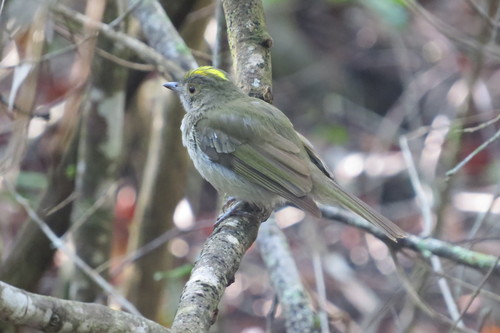
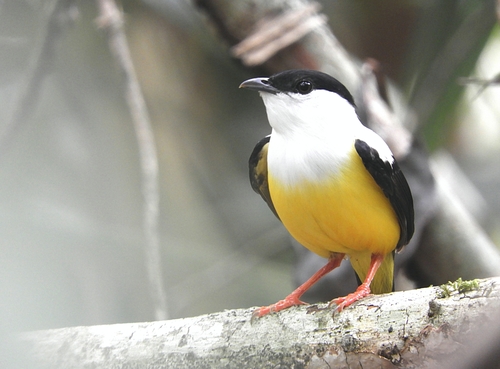
Like other manakins, the blue-backed manakin (Chiroxiphia pareola) is a compact, brightly colored forest bird. It typically reaches 13 cm in length and weighs 19 g. Adult males are mostly black, with a bright blue back and pale orange legs. Their crown is usually red, but the subspecies C. pareola regina from the southwest Amazon has a yellow crown instead. Females have olive-green upperparts, with slightly paler olive underparts. Young males are overall olive, but develop a red cap and the beginnings of a blue back as they mature. The subspecies C. p. atlantica, which is endemic to Tobago, is larger than other populations, and has more extensive red crown coloring and blue back coloring. Researchers have suggested that this Tobago population qualifies as a separate species called the Tobago manakin, but no major taxonomic authorities currently recognize this split. This species is closely similar to the lance-tailed manakin, Chiroxiphia lanceolata, which breeds further north, ranging from northern Venezuela to Costa Rica. The lance-tailed manakin differs by having elongated central tail feathers, and its males have a slightly brighter blue back.
The blue-backed manakin is distributed across southern Colombia, eastern Venezuela, the Guyanas, northeast Brazil, the Amazon Basin in Brazil, Bolivia, Ecuador and Peru, and the island of Tobago. A separate disjunct population occupies a roughly 3000 km long coastal strip in southeast Brazil. This species is entirely absent from the northwest Amazon Basin, the region stretching from central Venezuela to the southern border of Colombia. It is a fairly common bird found in both dry and moist deciduous forests, and does not live in rainforest.
The male blue-backed manakin has a distinctive breeding display that is unusual for being cooperative rather than competitive. Two males perch next to each other on a bare stick, and jump up and down alternately while giving a buzzing call. When a female approaches, the perched male moves backwards under the jumping male, so the two perform a vertical circling movement. Groups of up to eight birds may display together, with each pair of displaying males using a separate bare stick. The female builds a twig nest in a tree, and lays two brown-mottled white eggs. She incubates the eggs entirely alone, for a period of about 20 days. In addition to the buzzing call produced during display, the blue-backed manakin makes a range of other vocalizations, including a whee-whee-CHUP call that is sometimes given by two males in synchrony. Blue-backed manakins feed on fruit alongside some insects.