About Chiroxiphia linearis (Bonaparte, 1838)
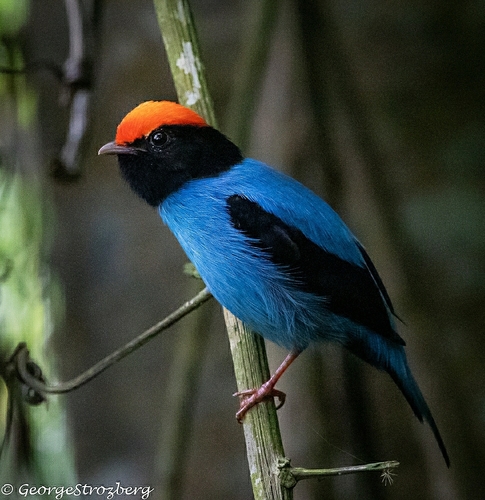
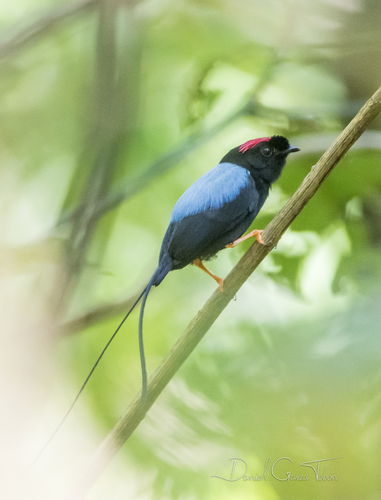
This species is the long-tailed manakin, Chiroxiphia linearis (Bonaparte, 1838). It is large for a manakin, measuring around 10 cm (3.9 in) long and weighing 18 g (0.63 oz). Males are mostly a rich deep black, contrasted by a bright red crown and bright red legs, with a bright blue back. The two central tail feathers are narrow and greatly elongated. Females are olive green, with paler coloration on the underside, chin, and throat; some females have a small amount of red in the crown. It closely resembles four other Chiroxiphia species: the lance-tailed manakin C. lanceolata, the blue-backed manakin C. pareola, the swallow-tailed manakin C. caudata, and the Yungas manakin C. boliviana. All of these related species share the same red crown and blue back pattern, but there is no range overlap between long-tailed manakin and these four species. The long-tailed manakin is distributed across Costa Rica, El Salvador, Guatemala, Honduras, Mexico, and Nicaragua. Its natural habitats are subtropical or tropical dry forest, subtropical or tropical moist lowland forest, and heavily degraded former forest. Long-tailed manakin males have a notable social and reproductive system. Males form long-term partnerships as duos or trios. They sing synchronously together, and perform a complex coordinated courtship dance for any female attracted to their singing. If the female mates, only the alpha male in the partnership inseminates her. Across the many displaying male partnerships that form a dispersed lek in one locality, only one or a very small number of males account for the vast majority of matings in a single breeding season. Like in other lekking species, females build the nest and raise young on their own, with no involvement from males.