About Chiroxiphia lanceolata (Wagler, 1830)
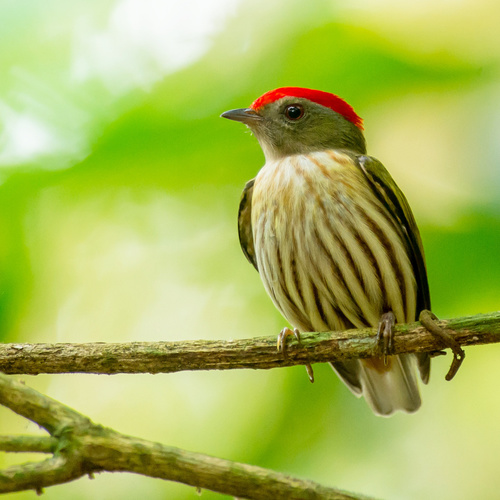
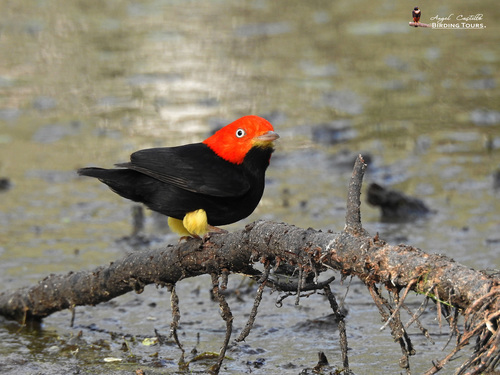
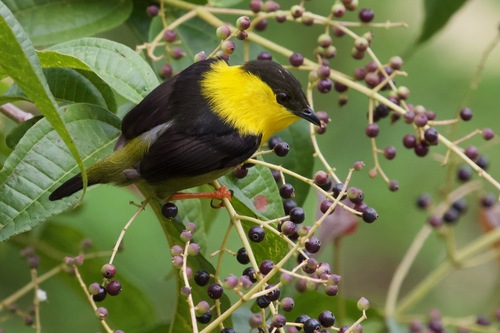
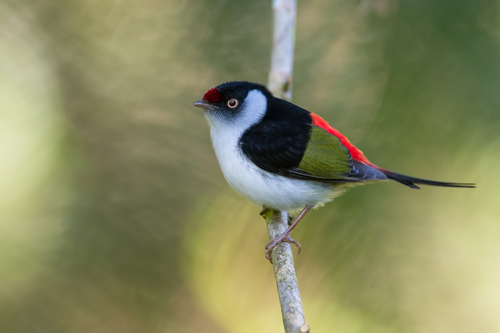
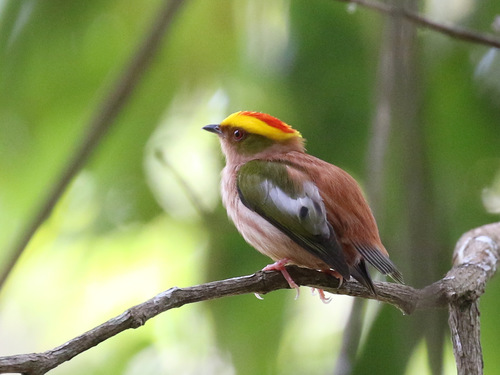
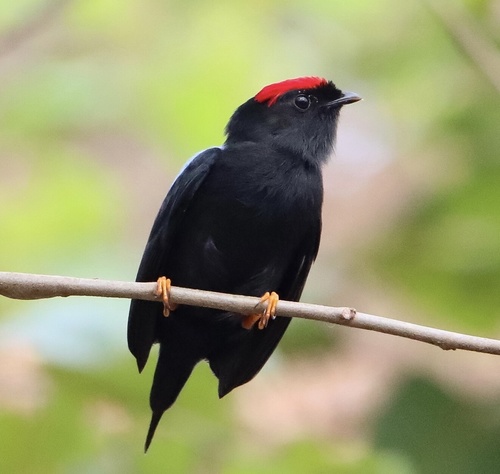
Chiroxiphia lanceolata, commonly called the lance-tailed manakin, is a compact, brightly colored forest bird, similar to other manakin species. Adults typically measure 13.5 cm long and weigh 17.5 g. Both sexes have bright orange legs, and two elongated central tail feathers that form a spike. Females are olive-green with slightly paler underparts. Most females have solid green plumage, but a small portion have tawny or red caps. Adult males are mostly black, with a red cap and a sky-blue back. Young males are olive-colored, but develop a red cap and the beginnings of a blue back as they mature. Males do not grow their full adult plumage until approximately 26 months after hatching. This species is similar to the blue-backed manakin, Chiroxiphia pareola, which breeds further south and east. Chiroxiphia pareola lacks the lance-tailed manakin's spiky tail, and breeding males of this species have a somewhat darker blue back. Male lance-tailed manakins have an unusual cooperative breeding display, rather than the competitive displays seen in many other species. Two males perch next to each other on a bare stick and jump up and down alternately, sometimes making short flights. Groups of birds may perform together, with each displaying pair using a different stick. The female builds a cup-shaped nest in a tree, then lays two brown-mottled cream eggs. She incubates the eggs entirely alone for around 20 days. This species produces a number of distinct calls, including a Toe-LEE-do, a curry-ho, and a frog-like buzzing croak given by displaying males. Lance-tailed manakins feed on fruit and some insects.