About Chiropsalmus quadrumanus (F.Muller, 1859)
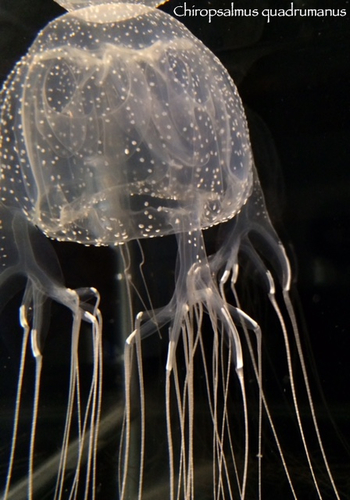
Chiropsalmus quadrumanus is a cube-shaped, colourless, transparent jellyfish, with a diameter of approximately 14 centimetres (5.5 in) and a slightly shorter height. Its body is made of gelatinous material; the top edges are rounded, and the top surface is flat. Bundles of 7 to 9 tentacles hang from pedalia—palmate appendages located at the four lower corners of the bell, with one tentacle on each "finger". The outer two tentacles are pinkish, while the inner tentacles are yellowish white, and all tentacles can reach 3 to 4 metres (9.8 to 13.1 ft) in length. A horizontal ring of tissue called the velarium sits halfway up the inside of the bell, partially blocking the bell's aperture. A central column called the manubrium hangs down inside the bell, with the mouth at its tip. The rounded stomach has four pouches that connect to radial sinuses along the edges of the bell, and gonads are located on either side of the radial canals.
Chiropsalmus quadrumanus is distributed along the east coast of North America, including North and South Carolina, Georgia, Florida, Alabama, Mississippi, Louisiana, Texas, as well as the Caribbean, the Gulf of Mexico, and Mexico; there is also a separated population in Brazil. It can also be found in the Pacific Ocean, with reports of occurrence in Hawaii and Australia. It typically inhabits warm open seas, but sometimes appears in large numbers in inshore areas where it has not been recorded before. This type of inshore influx happened on the Texas Gulf coast in 1955 and 1956, coinciding with local drought conditions and resulting high water salinity. These jellyfish are rarely seen near the surface, but small specimens are often caught in shrimp trawls. Large quantities get washed up onto beaches after gales, and many dead jellyfish can be found floating on the surface after heavy rains. The jellyfish disappear from the area once conditions return to normal.
The long tentacles of Chiropsalmus quadrumanus are equipped with nematocysts, which the jellyfish uses to capture prey like small fish and deter predators. These nematocysts can deliver an extremely painful sting to humans who encounter the jellyfish. One documented case records a four-year-old boy stung in the Gulf of Mexico who died forty minutes after being stung. Over a five-year period of recording stings off the coast of Brazil, 49 people were stung by jellyfish, and twenty of these incidents could be linked to identifiable species. Sixteen of these confirmed stings were caused by Chiropsalmus quadrumanus, and four were caused by the Portuguese man o' war (Physalia physalis). All stings from this species were linear, causing both intense pain and systemic symptoms. In addition to pain, symptoms include cardiac dysfunction and respiratory depression. The resulting rash can last for several months. If antivenom is given within a few hours, it eases pain to some degree, reduces the severity of the rash, and improves other symptoms. In extreme cases, prompt initiation of cardiopulmonary resuscitation can be effective.

