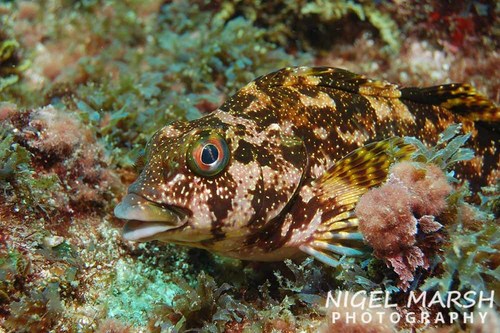
About Chironemus marmoratus Günther, 1860
Chironemus marmoratus, commonly called the large kelpfish, has a pointed snout and a small mouth. Its dorsal fin holds 14 to 15 spines and 16 to 20 soft rays, while its anal fin contains 3 spines and 6 to 8 soft rays. The maximum recorded standard length of this species is 40 cm (16 in). It has large pectoral fins; the upper rays are branched, and the lower rays are unbranched and robust. The body may be grey, brown, green, or pinkish. The head and body are covered in small white spots, and the body also has large dark blotches. This large kelpfish is found in the southwestern Pacific Ocean. In Australia, its range extends from Fraser Island in Queensland to the Gippsland Lakes in Victoria, and includes the islands of the Bass Strait, north-eastern Tasmania, and Lord Howe Island in the Tasman Sea. In New Zealand, it occurs around the North Island, between North Cape and East Cape. The species inhabits reef areas with kelp or other macroalgae in shallow water that is regularly exposed to powerful surges or waves. It is most often found in the intertidal zone or at depths around 10 meters. In northeast New Zealand, Chironemus marmoratus is commonly found in barren habitats alongside other fish species such as Girella tricuspidata and Parma alboscapularis. It is also sometimes found in shallow breakwater areas during the winter. One Australian study notes that this species is one of only a few species that have a trans-Tasman distribution, a pattern that is considered surprising because New Zealand was historically connected to Australia via the Gondwana landmass.

