About Chirocephalus diaphanus Prévost, 1803
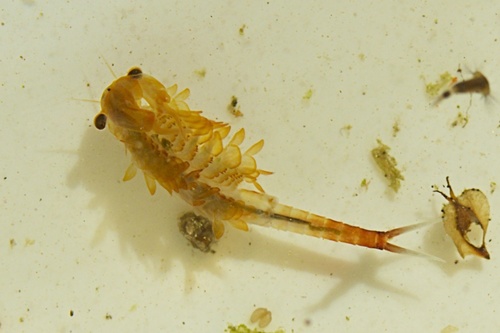
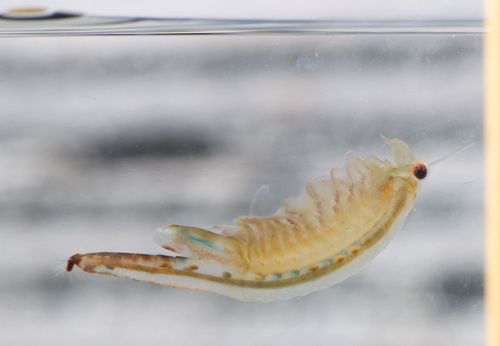
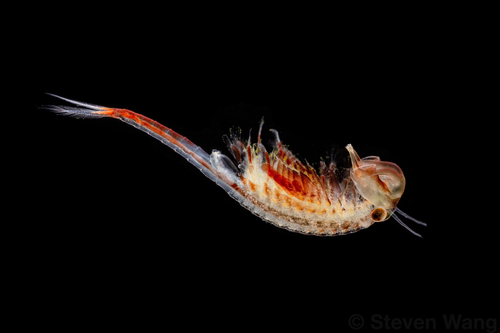
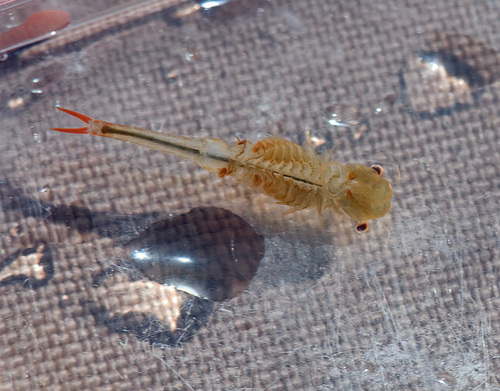
Chirocephalus diaphanus Prévost, 1803 is a beautiful, translucent crustacean. Its body is subcylindrical, and measures around 0.5 inches (13 mm) long. It is mostly transparent, but has black eyes, and red tips on its appendages and abdomen. The body widens toward the head, which has a distinct mandibular groove. The head bears a pair of stalked compound eyes, a sessile median eye, two pairs of antennae, and mouthparts made up of a backward-directed labrum covering the mouth, plus paired mandibles, paragnatha, maxillules, and vestigial maxillae. The thorax is composed of twelve body segments, with the twelfth (last) segment fused to the first segment of the abdomen. There is no carapace, but each of the eleven free thoracic segments bears a pair of phyllopodia, which have a series of bristles pointing along the animal's midline. The abdomen has seven segments that lack appendages, and ends in a slender telson that carries a pair of caudal rami. Males and females can be distinguished by a set of sexually dimorphic traits. Female antennae are triangular and relatively short, while male antennae are long and jointed; each male antenna also holds a complex frontal appendage used to clasp the female during mating. The last thoracic somite is fused to the first abdominal somite. In males, this fused region bears a pair of processes that are extensions of the vasa deferentia, forming a protrusible penis. In females, this region holds a single egg pouch, which is thought to develop from a pair of ancestral appendages. Chirocephalus diaphanus is a Mediterranean species that reaches its north-western distribution limit in Great Britain, and is absent from Fennoscandia. In Western Europe, its distribution runs almost continuously from Great Britain to the Iberian Peninsula, and extends east as far as the Rhine in Germany. Only one confirmed occurrence of C. diaphanus has been recorded in the Benelux countries, from pools in South Limburg, Netherlands. Further east, the species occurs south of 47°N on the Apennine and Balkan peninsulas, and reaches the Black Sea in Romania; an isolated population lives at the mouth of the Vistula river in Poland. In the Mediterranean basin, populations are found on Sicily, Sardinia and Crete. C. diaphanus is the only fairy shrimp species that occurs naturally in Great Britain; Tanymastix stagnalis is found in western Ireland, and Artemia salina formerly occurred in England. Within Great Britain, C. diaphanus is restricted to areas where precipitation is lower than evapotranspiration between April and September, meaning it is only found regularly in southern England, with scattered records as far north as Yorkshire. This fairy shrimp lives in temporary pools of water, ranging from seasonal ponds to muddy ruts, and prefers sites with regular disturbance such as that from passing tractors or livestock. It has a broad range of ecological tolerances for temperature, dissolved oxygen and pH, but cannot live alongside predatory fish. C. diaphanus swims with its ventral side facing upward, and is a filter feeder that collects zooplankton and detritus using its phyllopodia. The life cycle of Chirocephalus diaphanus is extremely fast. The typical full duration of its life cycle is not confirmed, but an estimate of around 3 months has been proposed. Its eggs are tolerant of drying out; when the habitat fills with water again, some eggs will hatch while others remain dormant. This adaptation allows the species to survive in unpredictable habitats, as some eggs remain in reserve if the habitat dries before the current generation can mate and produce new offspring. Dispersal between different bodies of water can occur via the movements of animals including cattle, deer and horses.