About Chioglossa lusitanica Bocage, 1864
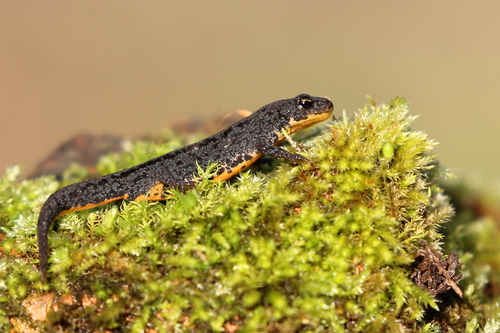
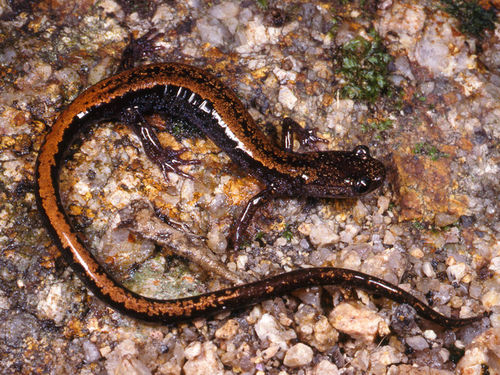
The gold-striped salamander (Chioglossa lusitanica Bocage, 1864) is a short-legged salamander with protruding eyes. Its tail accounts for two-thirds of its total body length. It has a smooth upper surface marked with 10 to 11 costal grooves; its dorsal base color is dark brown to blackish, and it usually has two parallel golden stripes on its back, which may sometimes be broken. This is an agile, nocturnal, terrestrial amphibian. When threatened, it can shed its tail like a lizard, and it has a typical lifespan of 8 to 10 years. It feeds mainly on invertebrates, catching prey with its sticky tongue. This species mates on land; females lay clutches of 12 to 20 eggs between stones in running water, or on the walls of caves. Larvae of this salamander develop in water. There are two described subspecies: C. l. lusitanica and C. l. longipes. Its native natural habitats are moist deciduous forests near streams in the mountainous regions of northwest Spain, and northern and central Portugal. It has also been introduced to the Sintra Mountains. It can additionally be found in eucalypt plantations, pine forests, and shrubland. It has also been recorded in caves and abandoned flooded mines. It is present in several protected areas, including Peneda-Gerês National Park in Portugal, and Picos de Europa National Park in Spain.