About Chinavia hilaris
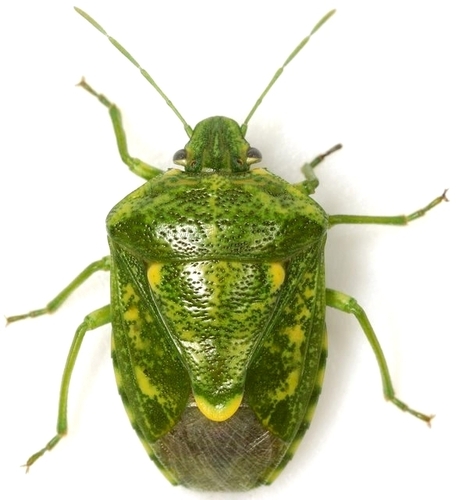
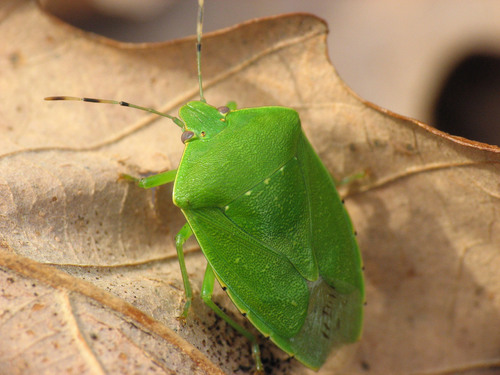
Chinavia hilaris, commonly known as the green stink bug, is typically bright green with narrow yellow, orange, or reddish edges. It is a large, shield-shaped bug with an elongated oval form, measuring between 13 and 18 mm in length. It can be distinguished from the species Nezara viridula by the black coloration of its outermost three antennal segments. Its anterolateral (front and away from the midline) pronotal margin is relatively straight, rather than the strongly curved margin seen in Chinavia pensylvanica. Both adults and nymphs have large stink glands on the underside of the thorax that extend more than halfway to the edge of the metapleuron. When disturbed, they discharge large amounts of foul-smelling liquid from these glands. Historically, dried and pulverized samples of this liquid were used industrially to enhance the scent of some acids, though this use has now been replaced by artificial compounds. This species is found in orchards, gardens, woodlands, and crop fields throughout North America. It uses its needle-like mouthparts to feed on the juices of a wide variety of plants from May until the first frost. Its native range extends from the eastern United States (from New England to Florida) west to the 98th west longitudinal line. It is rarely found west of this boundary, though it occurs in moderate numbers along the U.S. West Coast, from San Diego, California to Seattle, Washington. Adults prefer feeding on developing seeds, which makes them a crop pest for tomato, bean, pea, cotton, soybean, and eggplant. When no seeds are available, they also feed on stems and foliage, damaging a number of fruit tree species including apple, cherry, orange, and peach trees. Earlier in the growing season, green stink bugs occur more often on non-crop host plants than other stink bug species. Non-crop plants like black cherry, elderberry, mimosa, and pecan grow along farmscape edges, providing a safe development site for immature stink bugs and acting as a gateway into agricultural fields. Unlike cotton, peanuts and corn are not counted as host crops. Corn’s tall field edges have been shown to slow the spread of green stink bugs into nearby host crops. Adults emerge in fields in early September, and become abundant in sheltered locations. Mating occurs in early October, and eggs can be found from mid to late October. Nymphs hatch in late October and early November. Two or three generations can develop per year during summer months in field conditions, and at 26 °C in laboratory settings. Adult females attach their keg-shaped eggs to the underside of foliage in double rows of twelve or more eggs. These egg clusters are nearly cylindrical in shape, and change color from light green, to yellow, to light pink as the embryos inside near hatching. The length of time between egg laying and hatching gets shorter as temperature increases. Green stink bugs produce one generation per year in the northern part of their range, and two generations per year in the southern part. Early instar nymphs are brightly colored with stripes, and turn green as they approach adulthood. Eggs are usually laid in clusters of 14, though some clusters have fewer; 9 eggs is the smallest cluster size recorded in 77 observations. Eggs can be laid on the undersides of leaves, on plant stems, or on the flowers of salvia.