About Chimonanthus praecox (L.) Link
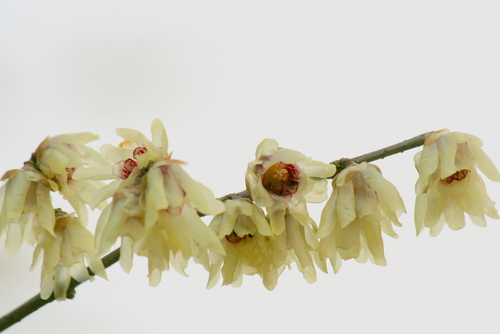
Chimonanthus praecox, commonly called wintersweet and Japanese allspice, is a flowering plant species belonging to the genus Chimonanthus in the family Calycanthaceae. It is native to China, where it is called làméi (蠟梅) in Chinese. It is also cultivated in Iran, where it is known as gol-e yakh (گلیخ), meaning "ice flower" in Persian. This is a vigorous deciduous shrub that grows up to 4 m (13 ft) tall, with an erect trunk. Its leaves are 5–29 cm (2–11 in) long and 2–12 cm (1–5 in) broad. It produces strongly scented, pendent flowers in winter, between November and March in the UK, that grow on bare stems. The flowers bear 15 to 21 yellow or pale green-yellow tepals; the inner tepals usually have purplish red markings. This shrub is cultivated in gardens, where it provides desirable floral color during the dormant season. Two cultivars, C. praecox 'Grandiflorus' and C. praecox 'Luteus', have received the Royal Horticultural Society's Award of Garden Merit. This plant is not closely related to true allspice, Pimenta dioica. In cultural use, C. praecox is a common motif in traditional Persian poetry, literature, and music. A modern example of its appearance in Persian music is Kourosh Yaghmaei's piece Gol-e Yakh.