About Chilomycterus reticulatus (Linnaeus, 1758)
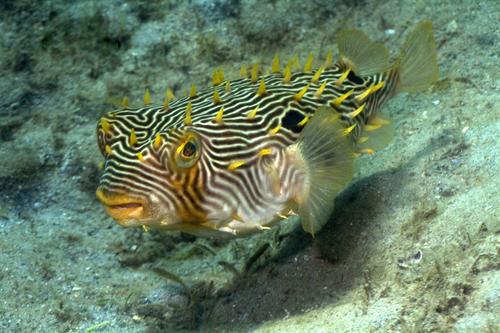
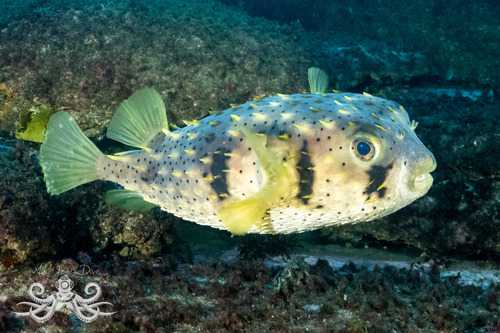
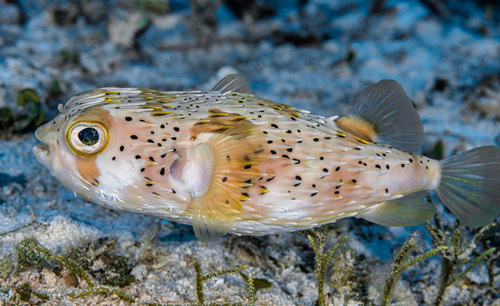
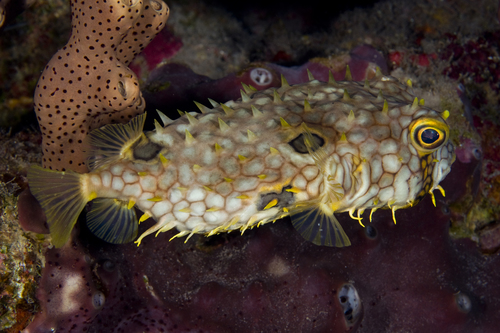
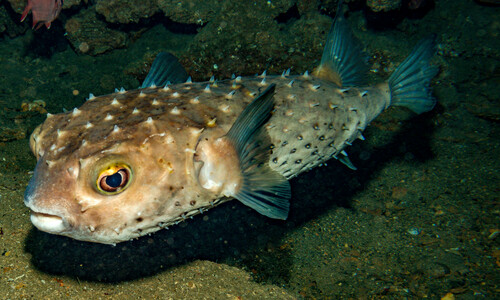
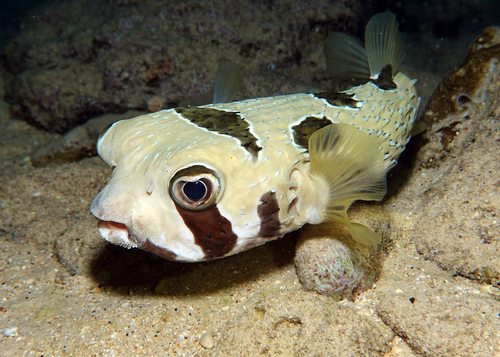
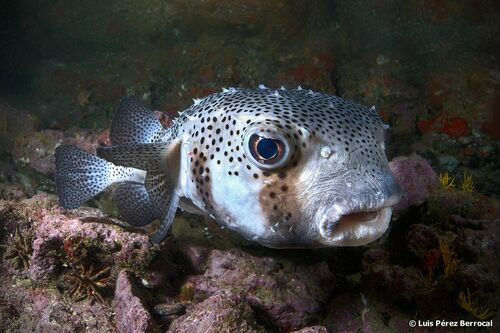
Chilomycterus reticulatus has a rotund, inflatable body, with a wide, blunt head and large eyes. The nasal organ of adult individuals sits in an open, pitted cup, while in juveniles it is a tentacle with two openings. The teeth are fused into a parrot-like beak with no frontal groove, and the mouth is large. This species has no spines on its fins, and has no pelvic fins at all. The dorsal fin has 12 to 14 rays, the anal fin has 11 to 14 rays, the caudal fin has 10 rays, and the large pectoral fins have 19 to 22 rays. The body is covered in small spines that are triangular in cross-section; some of these spines are reduced to plates under the skin. A row of 8 to 10 spines runs from the head to the dorsal fin, and there are one or two spines on the caudal peduncle. Adult C. reticulatus are grey to brown in color, with a black gular band and small black spots on their upper body surfaces and fins. Pelagic juveniles are blue with dark spots on their upper body, and these spots extend down to the belly. This species reaches a standard length of 50 cm, though individuals up to 75 cm have been recorded. Chilomycterus reticulatus has a rather patchy distribution in warm temperate seas across the globe. It is found in the Pacific, Atlantic (including the Gulf of Mexico and Mediterranean Sea), and Indian Oceans. In the Atlantic, it ranges as far north as North Carolina in the west and Portugal in the east, and south to South Africa and Brazil. In the Indo-Pacific, it extends north to Japan and south to northern New Zealand. In the eastern Pacific, it occurs from Chile north to California.