About Chilocampyla dyariella Busck, 1900
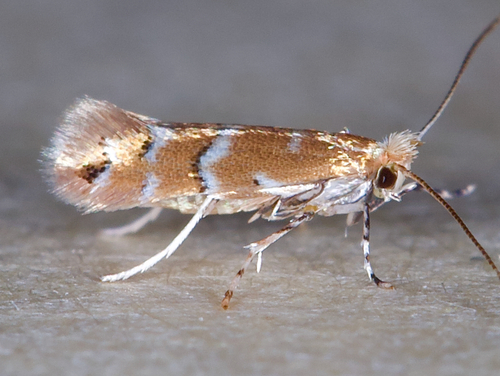
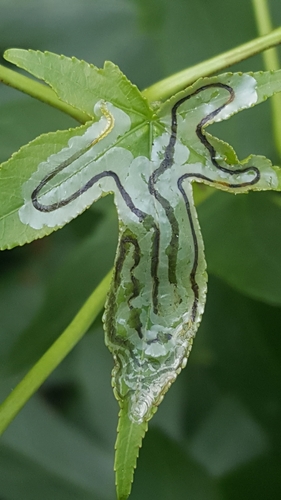
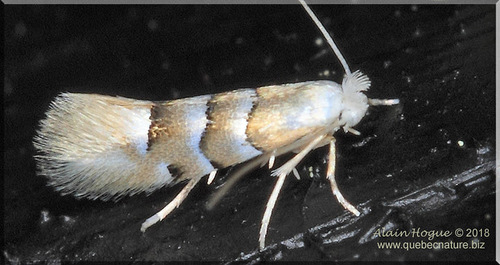
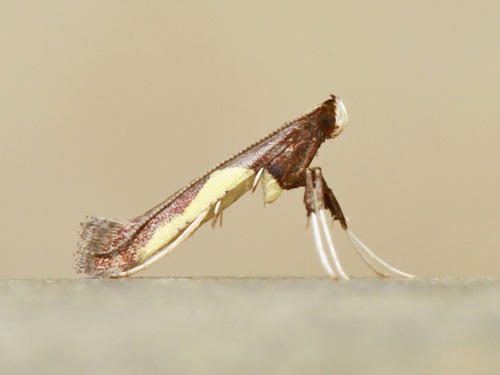
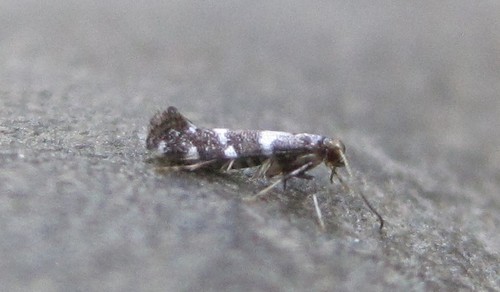
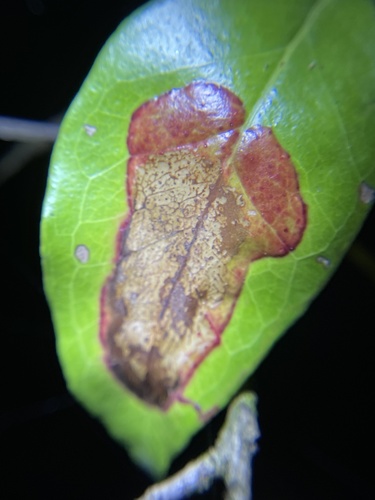
Chilocampyla dyariella is a moth species belonging to the family Gracillariidae. It has been recorded in Florida, United States. The wingspan of this moth ranges from 7 to 8.5 millimeters. The larvae of Chilocampyla dyariella feed on multiple species of the genus Eugenia: Eugenia axillaris, Eugenia foetida, Eugenia garberi, Eugenia procera, and Eugenia rhombea. Larvae create mines inside the leaves of their host plants. The leaf mine starts as a long narrow line running along the edge of the leaf for approximately 25 millimeters. It then turns inward toward the center of the leaf and suddenly broadens into a large, bladder-like blotch that nearly covers the entire leaf. This mine separates the upper and lower epidermis of the leaf, leaving the leaf inflated and soft to pressure, similar to an air cushion. The mine appears whitish green on the underside of the leaf, and is discolored purple on the upper side. The interior of the mine has an appearance resembling a small whitish pearly fungus overgrowing the surface. The larva of this species is cylindrical, clear and transparent, with sparse white hairs and 14 legs. Its head is light brown, with darker reddish brown sutures and two black eyespots. When the larva is fully grown, it exits the leaf mine, turns a vivid wine red color, and spins a dense, oval, yellowish grey cocoon inside a slight fold of the leaf. The pupa is white when it first forms, and develops the same coloration as the adult moth when it reaches maturity.