About Chilades parrhasius (Fabricius, 1793)
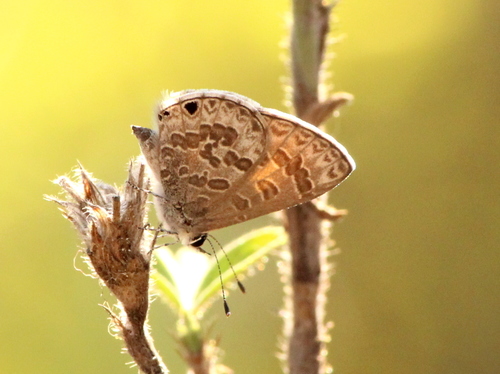
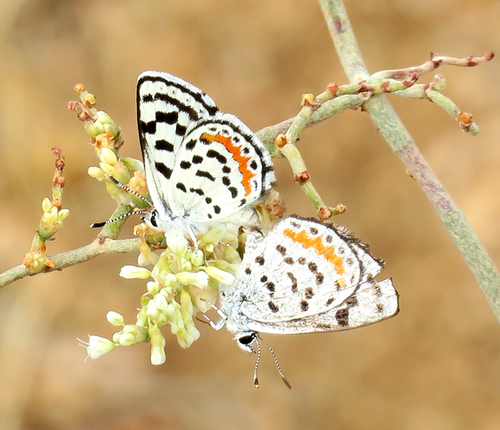
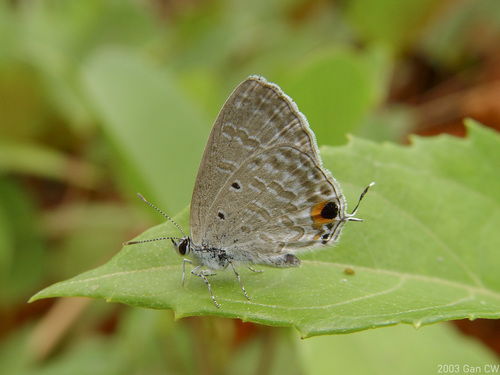
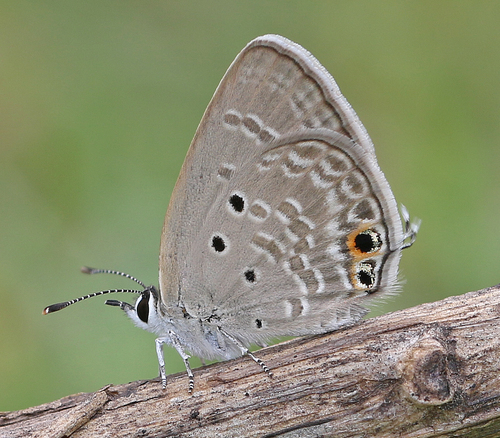
Wet-season brood: Male. Upperside is dark greyish-blue with a lilac tint. The forewing has a black terminal band that widens slightly toward the apex. The hindwing has a broadly blackish costal margin; its outer margin has a narrow black band, where the upper portion is formed by a series of connected spots with pale inner edges, and black marks often extend a short distance up the veins. There are two large jet-black spots in interspaces 2 and 3, plus two tiny black spots at the anal angle, and all these spots are more or less capped with orange. Tails are black with white tips. The forewing's cilia are grey, while the hindwing's cilia are white with black points at the vein ends. Underside is greyish-white, and all markings have white edges. The forewing has a lunular (crescent-shaped) mark at the end of the cell, plus a discal row of six lunular marks aligned in a line, with the uppermost mark positioned slightly inward. The hindwing has three small sub-basal black spots, with the middle spot placed well inward; it also has another similar sub-apical spot close to the costa. There is a slender mark at the end of the cell, and a discal row of six lunular marks: the uppermost mark is inward, just below the sub-apical black spot, the lowest mark is also well inward, and the remaining marks form a gentle outward curve. The discal row on both wings is well separated from the marginal series. Both wings have a terminal brownish line and a sub-terminal series of marks, which are lunular on the hindwing; between these structures runs a row of brownish spots. The two spots in interspaces 2 and 3, and sometimes an additional spot in interspace 4, are black and large, with some metallic specks and capped with faint orange. Antennae are black, ringed with white. Head and body are blackish on the upper side with blue pubescence, and white on the underside. Female. Upperside is paler than that of the male, and the blackish bands on both wings are much broader. A blackish lunular line is generally present at the end of the cell on both wings. Underside is whiter than that of the male. The discal series is similarly well separated from the marginal series in both wings, and the lunular marks that make up the series are darker and more prominent. Dry-season brood: Male and female. Upperside is pale lilacine greyish-blue; veins are more or less prominent, terminal bands are narrower and much paler. The orange-capped black spots on the hindwing are small and generally present in both sexes. Underside markings are similar to those of the wet-season form, but are very small and indistinct.