About Chicoreus ramosus (Linnaeus, 1758)
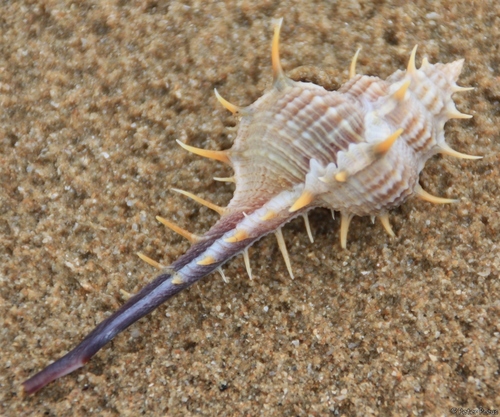
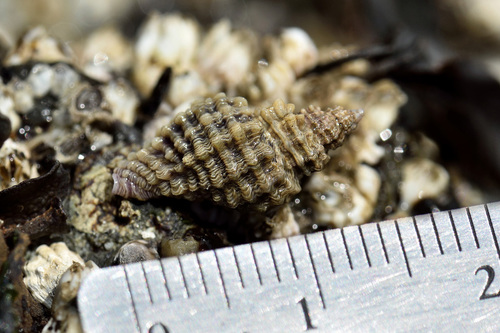
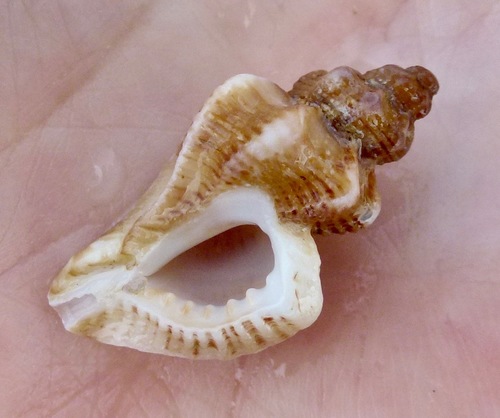
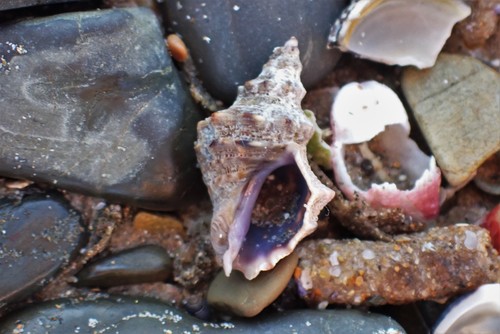
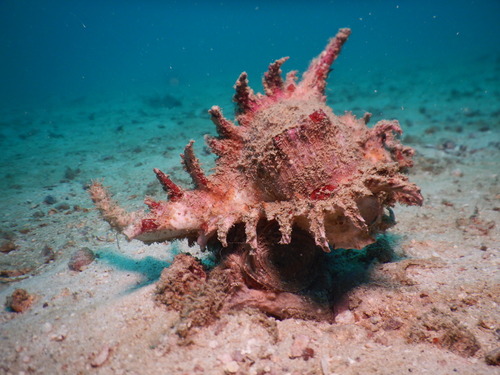
Chicoreus ramosus, commonly known as the ramose murex, is a species of sea snail. Its shell is large, solid, very rugged, and heavy, reaching a maximum length of 330 mm. The shell has a relatively globose overall shape, with a short spire, a slightly inflated body whorl, and a moderately long siphonal canal. One of its most noticeable ornamental features is its conspicuous, leaf-like, recurved hollow digitations. Each whorl also has three spinose axial varices, with two elongated nodes between each pair of varices. The external surface of the shell ranges in color from white to light brown; the aperture is white, and is typically pink near the inner edge, outer lip, and columella. This sea snail is widely distributed across the Indo-West Pacific. It ranges as far west as eastern South Africa, and can also be found in Mozambique, Tanzania, Madagascar, the Red Sea, the Gulf of Oman, Aldabra, Chagos, and Mauritius. Its distribution also extends to eastern Polynesia, southern Japan, New Caledonia, and Queensland, Australia. Ramose murex live on sandy and rubble bottoms near coral reefs, at depths up to around 10 m.