About Chesias legatella (Denis & Schiffermüller), 1775
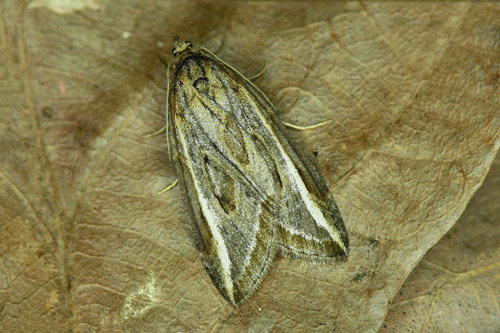
Chesias legatella, commonly known as the streak, is a moth species belonging to the family Geometridae. It was first described by Michael Denis and Ignaz Schiffermüller in 1775. This moth is distributed across northern and western Europe, as well as North Africa. It is common throughout Britain, while in Ireland it is localized and restricted to the northern part of the island. The species shows noticeable variation in appearance: its forewings are typically buff or brown, but it can always be easily recognized by the prominent whitish apical streak that gives the species its common name. Its hindwings are pale grey or buff, and its wingspan measures between 35 and 38 millimetres, or 1.4 to 1.5 inches. A full description of the species can be found in work by Prout. Mature larvae are usually dark green, with a darker dorsal line that has paler edges, and a broad whitish or yellowish subdorsal line. They have a distinct white lateral stripe and three white lines on their ventral side. Their spiracles are red and outlined with black rings. Larval body color adapts to the larva's environment: a yellow form is common on plants that have a great deal of bloom, while a heavily blackened form has been recorded from dry, stunted plants. The pupa is red-brown, darker on its dorsal side, with green-tinged wings. This moth typically flies at dusk during September and October; this flight season reference applies specifically to the British Isles, and timing may differ in other parts of the species' range. Adults are sometimes attracted to light. Larvae most commonly feed on broom, and have also been recorded feeding on yellow bush lupin. The species overwinters in the egg stage. Pupae are buried deep in the ground and do not form a cocoon.