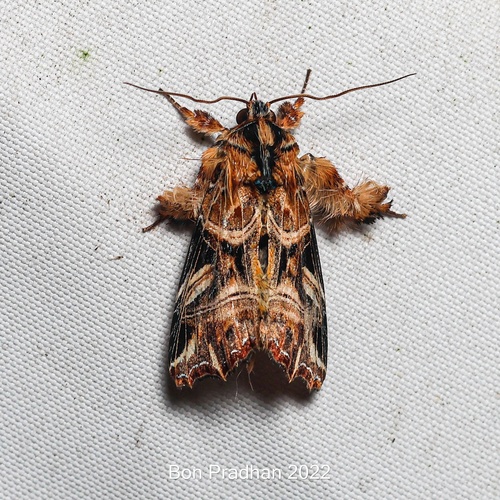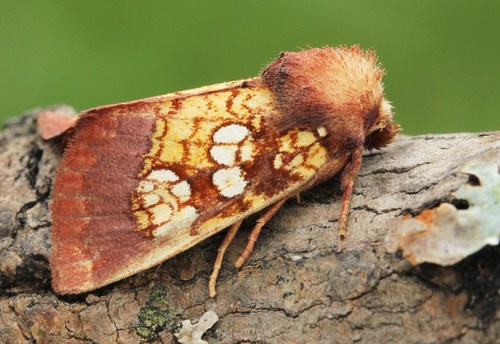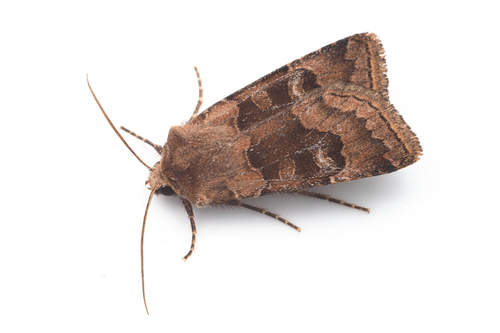
About Chersotis cuprea (Denis & Schiffermüller), 1775
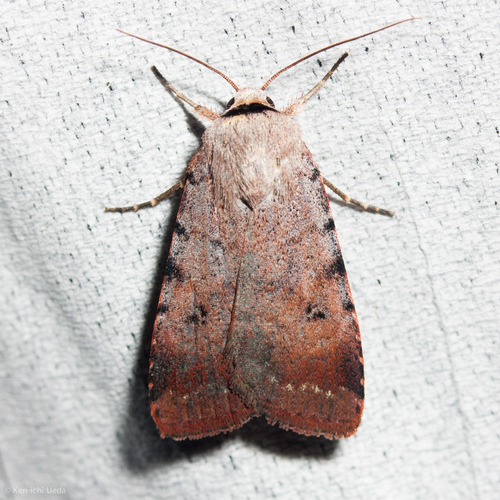
This moth species, Chersotis cuprea, shows high variability in basic body color. Adult males have a wingspan of 32–36 millimetres (1.3–1.4 in), while adult females have a wingspan of 33–39 millimetres (1.3–1.5 in). Usually, the upper side of the forewings is coppery reddish brown, which is the origin of the species Latin name cuprea, with dark brown markings that have a thin whitish border. The underside of the forewing is dark gray-brown, and the hind wings are solid monochrome gray-brown. Caterpillars are gray-brown, with dark dorsal markings and bright side stripes. In 1914, Warren described this species under the name R. cuprea Schiff. (= haematitedea Esp.) as having a dull brown forewing, with the median area below the subcostal vein being dark brown. In Warren's description, the veins and edges of stigmata are very finely pale, the stigmata are deep brown, the costa is dark with fine pale speckling and a dark shade before the submarginal line, and the hindwing is gray-brown with a yellowish fringe. Warren also noted larvae as dull brown, with three whitish dorsal lines, some oblique black subdorsal streaks, and a grey lateral line. The larvae feed and live on various low-growing plants. One early record mentions the species occurring in Northern Europe excluding Britain, Armenia, and Kamschatka. Its confirmed full distribution ranges across Northern Europe, the Pyrenees, and Central Europe extending south to Greece, and eastwards through Ukraine, Siberia, Turkey, the Caucasus, Armenia, and all the way to China and Japan. These moths inhabit forests, mountain forests, nutrient-poor grasslands, and especially partially humid alpine pastures.