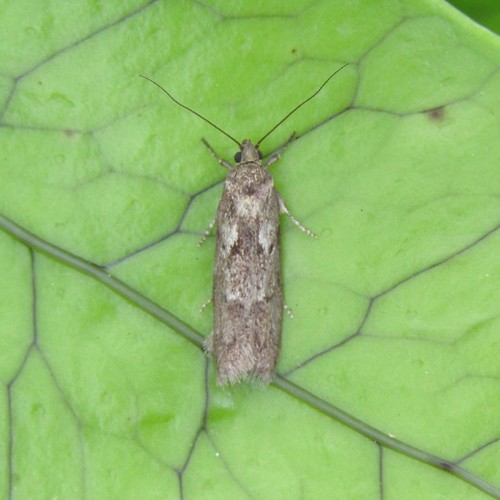
About Chersadaula ochrogastra Meyrick, 1923
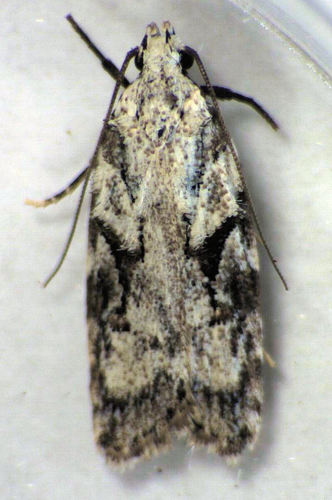
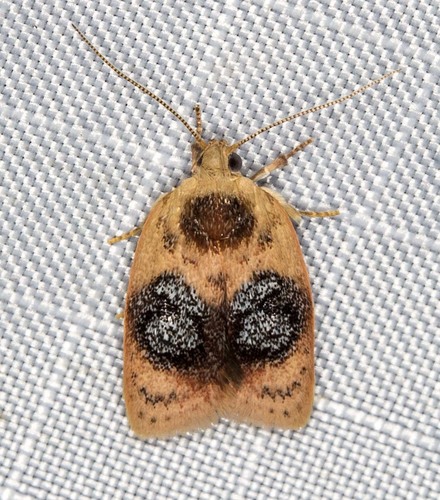
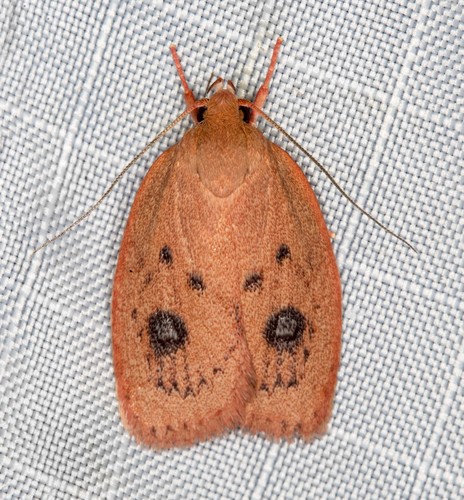
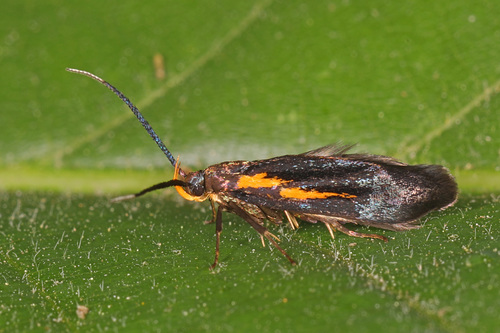
Chersadaula ochrogastra is a moth species first described by Meyrick in 1923. This species is endemic to New Zealand, where it has only been found in the North Island. It has not been collected since the year of its original description, 1923. The eggs of this species are white, cylindrical, slightly broader at one end, and approximately 3 millimetres long. When fully grown, larvae are roughly 2 centimetres long, cylindrical with a tapered end. The larval head is bright yellowish-brown; the anterior section of the body is yellowish-white, followed by a segment tinged with black, and the remaining body is whitish with irregular chocolate brown tinges. Male adults measure 17 millimetres, while female adults measure 16 millimetres. For males: the head is ochreous-whitish, with greyish hairs towards the base; palpi are ochreous-whitish mixed with grey; male antennal ciliations measure 1+1⁄2; the thorax is ochreous-whitish, slightly tinged with rosy and suffusedly mixed with grey; the abdomen is light yellow-ochreous. Male forewings are elongate, with a slightly arched costa, obtuse apex, and very obliquely rounded termen; they are light brownish, irregularly tinged with rosy-pink, and sprinkled with grey-white and dark fuscous. Markings on male forewings include a dark fuscous dot on the base of the costa, a spot of dark fuscous irroration in the disc towards the base, roundish dark fuscous stigmata with the plical stigma beneath the first discal stigma, opposite spots of dark fuscous suffusion on the costa and dorsum before these two stigmata that are suffusedly connected to them, some white suffusion preceding the plical stigma, a roundish blotch of dark fuscous irroration between the second discal stigma and the tornus preceded by narrow whitish suffusion, and an irregular, ill-defined, incomplete angulated subterminal line of dark fuscous irroration indented above the angle. Male forewing cilia are pale ochreous tinged with rosy, with the base sprinkled with dark fuscous. Male hindwings are dark grey, lighter towards the base, with grey cilia. For females: the abdomen is yellow-ochreous, grey on the sides and praeanal segment, with the anal segment whitish. Female forewings are broad-lanceolate, with the apex strongly and narrowly produced and pointed; their colour and markings are nearly identical to males, but the basal third is more whitish, angularly prominent in the disc, and there is a stronger blackish mark between the second discal stigma and the tornus. Female hindwings are rather broad-lanceolate, less than half the length of the forewings and about half as broad, with grey-white cilia. Adult females lay their eggs indiscriminately, and the eggs are not attached to any surface. Larvae live in silken cocoons underground and feed on grass roots. Larval preferred habitat is along the seacoast, approximately three metres above the high tide mark.