About Cheramoeca leucosterna (Gould, 1841)
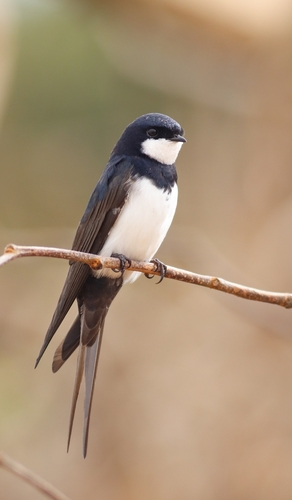
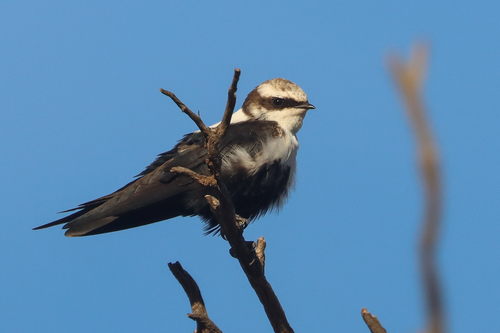
Adult white-backed swallows (scientific name Cheramoeca leucosterna (Gould, 1841)) average 15 cm in length, a size similar to that of other swallow species found in Australia. Adult individuals have a mottled grey cap positioned above white eyebrows, along with a grey eye. A dark stripe runs from the lores across the nape of the neck. The back and most of the breast are white, while the belly, wings and tail are black. This species has a deeply forked tail, and its wings are curved and pointed. The short bill is black, and the legs and feet are grey. It has a slender, streamlined body. The eyes have a prominent, dark iris. Male and female individuals have similar colouring, but adolescent white-backed swallows have duller overall colouration. This species is endemic to Australia, with a broad distribution across the continent. Its range spans from the southern latitudes of Australia north to the Tropic of Capricorn. Occasionally, after rainfall in inland areas, white-backed swallows expand their range to cover the entire southern portion of Australia, including its desert regions. White-backed swallows prefer open country, flying over open grassland and low shrubs. During the breeding season, they strongly favour habitats located around creek beds. No formal population count has been conducted for this species, but it is reported to be common. Population estimates suggest it is increasing, a trend linked to range expansion driven by land clearance and mining activity. Because of its large range and increasing population, the IUCN categorises the white-backed swallow as a species of least concern.