About Chenopodium vulvaria L.
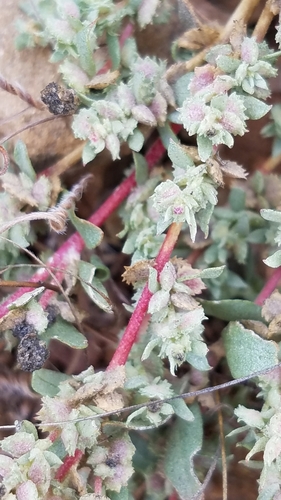
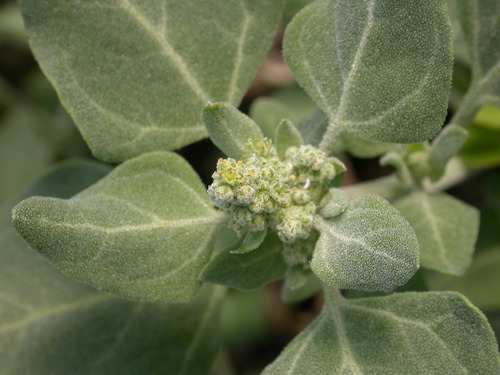
Chenopodium vulvaria L., commonly known as stinking goosefoot, is a small annual plant with a growth habit ranging from prostrate to ascending. Its stems reach up to 60 cm (2 ft) long, are roughly 2 mm in diameter, and have reddish ridges alongside green mealy hollows. The plant gives off a strong odor similar to rotten fish. Its leaves are grey-green, arranged alternately, and are either smooth-edged or bear a single tooth; they range in shape from ovate to kite-shaped, and measure 1.0–2.5 cm in length. Grey vesicular hairs cover the stems and the undersides of leaves, creating the plant’s distinct ‘mealy’ appearance.
The plant’s inflorescence is a cyme, made up of small clusters of rounded green flowers. Bisexual flowers have four to five tepals (perianth segments) and one to five stamens, while female flowers have just one style with two stigmas. Its fruits are membranous achenes that fall from the plant still attached to the remains of the perianth. The seeds are shiny, blackish, lens-shaped, roughly 1.2 mm in diameter, and marked with faint radial furrows on their outer seed coat (testa).
The native distribution of stinking goosefoot is not fully confirmed, but it is most likely native to the Mediterranean and Atlantic coasts of southern Europe and North Africa. It has spread northward through repeated introductions, which have generally not resulted in persistent long-term populations. In modern times, it has dispersed to many other regions around the globe, including North America, South America, extra-Mediterranean parts of Africa, and Australasia.
It has not yet been assessed for its global conservation status. In France, it is called Chénopode fétide, and is common in the south, holding the status LC (least concern) in Mediterranean départements. In northern France it is much rarer: it is classified as CR (critically endangered) in Picardy, VU (vulnerable) in Brittany, EN (endangered) in Alsace and Lower Normandy, and is considered extinct in Upper Normandy.
In Britain, surveys in the 1950s recorded stinking goosefoot around the Thames Estuary and the southern coasts of England and Wales, with scattered populations extending north to southern Scotland. A number of mostly historical inland sites were also recorded, but these were mostly considered to be introductions. Later studies documented a dramatic population decline, including the total loss of all inland populations; by the 1990s only 3 populations were thought to remain. It was assigned the conservation status VU (vulnerable) and protected under Schedule 8 of the Wildlife and Countryside Act 1981. Conservation actions included fencing sites to exclude rabbit grazing and rotovating soil to create bare ground. By 2020, the species had returned to its entire original range including Scotland, and its status was updated to EN (endangered), with it reclassified as an archaeophyte — a term usually meaning an introduction associated with farming or urbanisation.
In Spain, stinking goosefoot is classed as an annual therophyte of old fields, dispersed by ectozoochory, meaning its seeds attach to the skin, fur, or feathers of animals for transport. It is typical of bare ground, and disappears as abandoned land undergoes natural succession. By contrast, in Northern Europe it was historically often found on dung heaps, along roadsides, and at the bases of walls. This pattern has led to the conjecture that it is an archaeophyte frequently re-introduced from the south via various unknown transport routes.
Although it occurs in multiple plant communities in France, it is particularly characteristic of the Chenopodium vulvaria - Atriplex rosea association, found in the Camargue and other nearby areas. This community is described as highly nitrophilic and thermophilic, growing on wasteland near stables and other nitrogen-rich sites in the Mediterranean region. In central and eastern Europe, its typical habitat is the Malva neglecta – Chenopodium vulvaria community, which occurs on roadside verges and disturbed, trampled soils. Common associated plant species include rye grass, wall barley, and annual meadowgrass.
In Britain, stinking goosefoot was formerly a fairly widespread plant of farmland, waste ground, and tracks, growing in areas with plentiful bare ground. During the 20th century it retreated to just a few coastal sites, a change driven by shifting farming practices, particularly the replacement of manure with chemical fertilizer. It is tolerant of high soil nitrogen levels from animal dung. Its Ellenberg values in Britain are L = 7, F = 4, R = 7, N = 9, and S = 0, indicating it grows in full sunlight in places highly enriched with nitrogen, such as dung heaps and seabird roosts.
Pollination in goosefoots is generally either wind pollination or self-pollination, but no specific studies have examined pollination in stinking goosefoot. Nine insect species are recorded feeding on stinking goosefoot. One is the aphid Hayhurstia atriplicis (L.), which feeds on the leaves. Eight species of Lepidoptera (moths) are also associated with it in Britain. The larvae of Eupithecia simpliciata (Haworth), the plain pug, and Pelurga comitata (L.), the dark spinach, feed on its flowers and fruit. The remaining moth caterpillars eat its leaves and roots: these are Caradrina morpheus (Hufelagel, the mottled rustic); Trachea atriplicis (L.), the orache moth; Discestra trifolii (Hufnagel), the nutmeg; Lacanobia oleracea (L.), the bright-line brown-eye; Agrotis exclamationis (L.), the heart and dart; and Agrotis ipsilon (Hufnagel), the dark sword-grass. None of these insects feed exclusively on stinking goosefoot, and most feed on a wide variety of plants.
Following the doctrine of signatures, medieval herbals listed stinking goosefoot primarily for gynaecological uses. The herbalist Nicholas Culpeper praised the plant enthusiastically, noting it grows commonly on almost every dunghill, writing "the works of God are freely given to man, his medicines are common and cheap, and easily to be found. I commend it for an universal medicine for the womb, and such a medicine as will easily, safely, and speedily cure any disease thereof." By the 20th century, however, the plant had fallen out of use among herbalists. Trimethylamine (TMA), the chemical compound that gives stinking goosefoot its characteristic odor, is now used in industrial chemical processes and is known to be toxic at high concentrations.