About Chenonetta jubata (Latham, 1801)
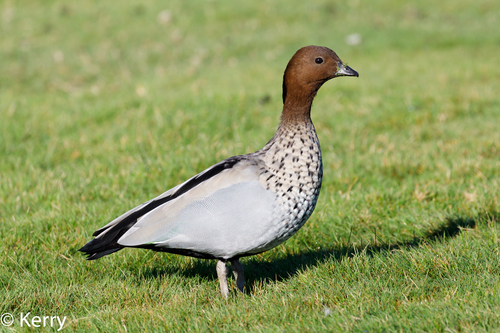
This duck, Chenonetta jubata, measures 45 to 51 cm (18 to 20 in) long and has an appearance similar to a small goose. It mostly feeds by grazing while in flocks. Males are grey with a dark brown head, a mottled breast, and very thin black and white stripes on their sides and flanks. Females have white stripes above and below the eye, plus mottled underparts. Both sexes have grey wings with black primary feathers and a white speculum. Juveniles resemble adult females, but are lighter in color and have a more streaky breast.
The Australian wood duck is widespread across Australia, including Tasmania. It inhabits grasslands, open woodlands, wetlands, flooded pastures, and coastal inlets and bays. It is also common on farmland that has dams, around rice fields and sewage ponds, and in urban parks. It is often found around deeper lakes that may be unsuitable for foraging by other waterbirds, because this species prefers to forage on land. It has been recorded as a vagrant species in New Zealand, and a pair successfully bred there in 2015 and 2016.
Australian wood ducks nest in tree cavities or nest boxes located above or near water. Their nests are built as a pile of down.